FindSEO
Hiring an agency

What Questions Should You Ask an SEO Agency Before You Hire?

The pitch questions that separate a capable SEO agency from a risky one, what good answers sound like, and a checklist to score every shortlist the same way.

FindSEO7 min read

Two people sitting across a light wooden table comparing notes on an iPhone and an iPad during a meeting.

Photo: Alejandro Escamilla / Wikimedia Commons (CC0)

In this article
  1. Why do the questions matter more than the pitch deck?
  2. What should you ask about your business and market?
  3. What should you ask about their method and first 90 days?
  4. What should you ask about content and links?
  5. What should you ask about results, reporting and proof?
  6. What should you ask about access, ownership and the relationship?
  7. What contract questions should you ask before you sign?
  8. An interview checklist before you hire
  9. The bottom line

Ask every SEO agency the same set of specific questions before you hire: about your business, their first 90 days, how they earn links, how they measure success, who owns your accounts, and what the contract actually commits to. Google's own hiring advice says no one can guarantee a number-one ranking, that you are responsible for work done in your name, and that you should ask for past work and speak to references. The answers tell you more than any slide deck.

This article expands the pitch questions into what a good answer sounds like and which replies should end the conversation. Our shorter printable questions to ask an SEO agency guide is useful in the meeting itself; use this piece to prepare. Pair it with checking reviews and case studies and the Academy lesson on evaluating proposals and red flags.

Why do the questions matter more than the pitch deck?

Most pitches sound alike. Everyone promises more organic traffic, everyone has a dashboard, and everyone claims to be data-driven. The difference between a useful partner and an expensive mistake shows up when you ask concrete questions and listen carefully. Google's page Do you need an SEO? is short and worth reading before any meeting: it lists questions to ask, warns against ranking guarantees and "special relationships" with Google, and reminds you that you are responsible for the companies you hire.

Arrive with three things already written down: a clear business goal (not "more traffic"), your current Search Console and Analytics numbers, and a budget range. Our guides to setting SEO goals and KPIs and SEO cost help with the first and third. Without those, every agency invents its own definition of success.
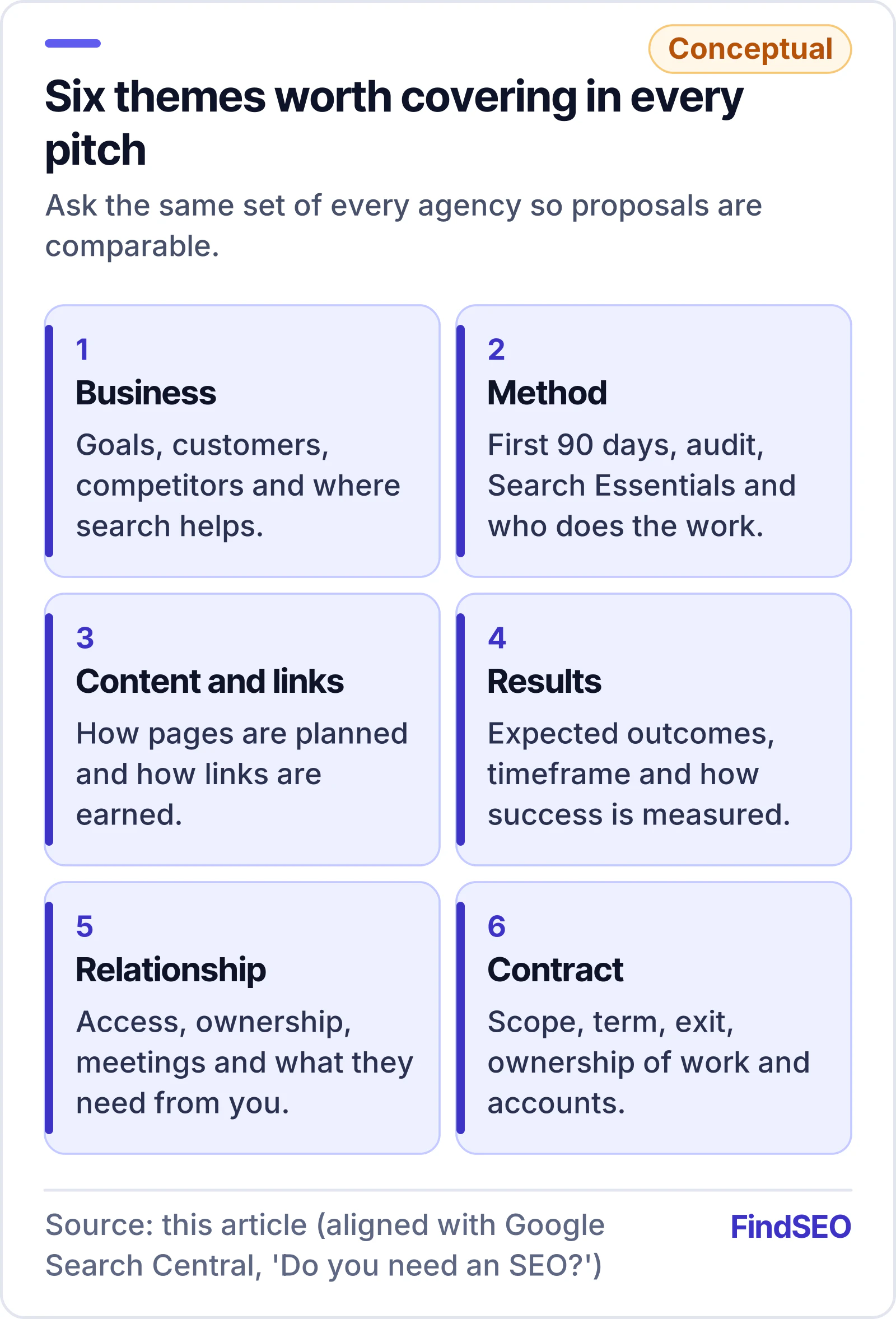
Six themes of questions to ask an SEO agency before hiring: business goals and competitors; method including the first 90 days and audit; content and link earning; results and measurement; the working relationship and account ownership; and the contract covering scope, term and exit.
Cover every theme with every agency on the shortlist, so you can compare answers side by side.

What should you ask about your business and market?

A good agency spends early time on you, not on itself. Google suggests they ask what makes your business unique, who your competitors are, how search results can help, and how customers find you. Flip that into questions you ask them:

  1. What would you need to know about our business to do this well? Good answers mention customers, margins, sales process, seasonality, priority services and locations. A weak answer jumps straight to a keyword list.
  2. Who do you see as our real competitors in search? Directories, marketplaces and publishers often compete for the same results as commercial rivals. An agency that has looked at your market before the meeting will have an opinion.
  3. What experience do you have in our industry, country or city? Industry experience matters most in regulated fields where E-E-A-T carries more weight. Local experience matters for area-based services. Browse SEO agencies in Australia or Melbourne SEO agencies when geography is part of the brief.

If the meeting opens with a long deck about the agency and never digs into your customers, note it.

A person writing notes in a notebook on a wooden coffee-shop table beside a laptop, a cup of coffee and a smartphone.
Write the answers down. The same questions asked of every agency make proposals comparable. Photo: Tran Mau Tri Tam, CC0, via Wikimedia Commons.

What should you ask about their method and first 90 days?

"What would you do in the first 90 days, and why in that order?" is the single most useful question. A competent agency describes a sequence: usually access and audit, then priorities, then foundation fixes, then content and authority work. They should explain why. Our guide to the first three months of SEO describes a sensible start.

Follow up with:

  1. What does your SEO audit cover, and what do we get at the end? You want a prioritised fix list with effort and impact, not a raw crawl export. Google says an audit should give realistic estimates of improvement and of the work involved.
  2. Do you follow Google's Search Essentials? The answer should be an unhesitating yes, with a short explanation of how that shapes technical work, spam avoidance and content quality.
  3. Who will actually do the work? Meet the people on the account, not only the salesperson. Ask how many other clients they handle and whether any work is outsourced or white-labelled.
  4. How do you handle technical changes on our site? Some agencies implement fixes, some write specs for your developers, some only list problems. Each model can work if someone is clearly responsible for getting changes live.
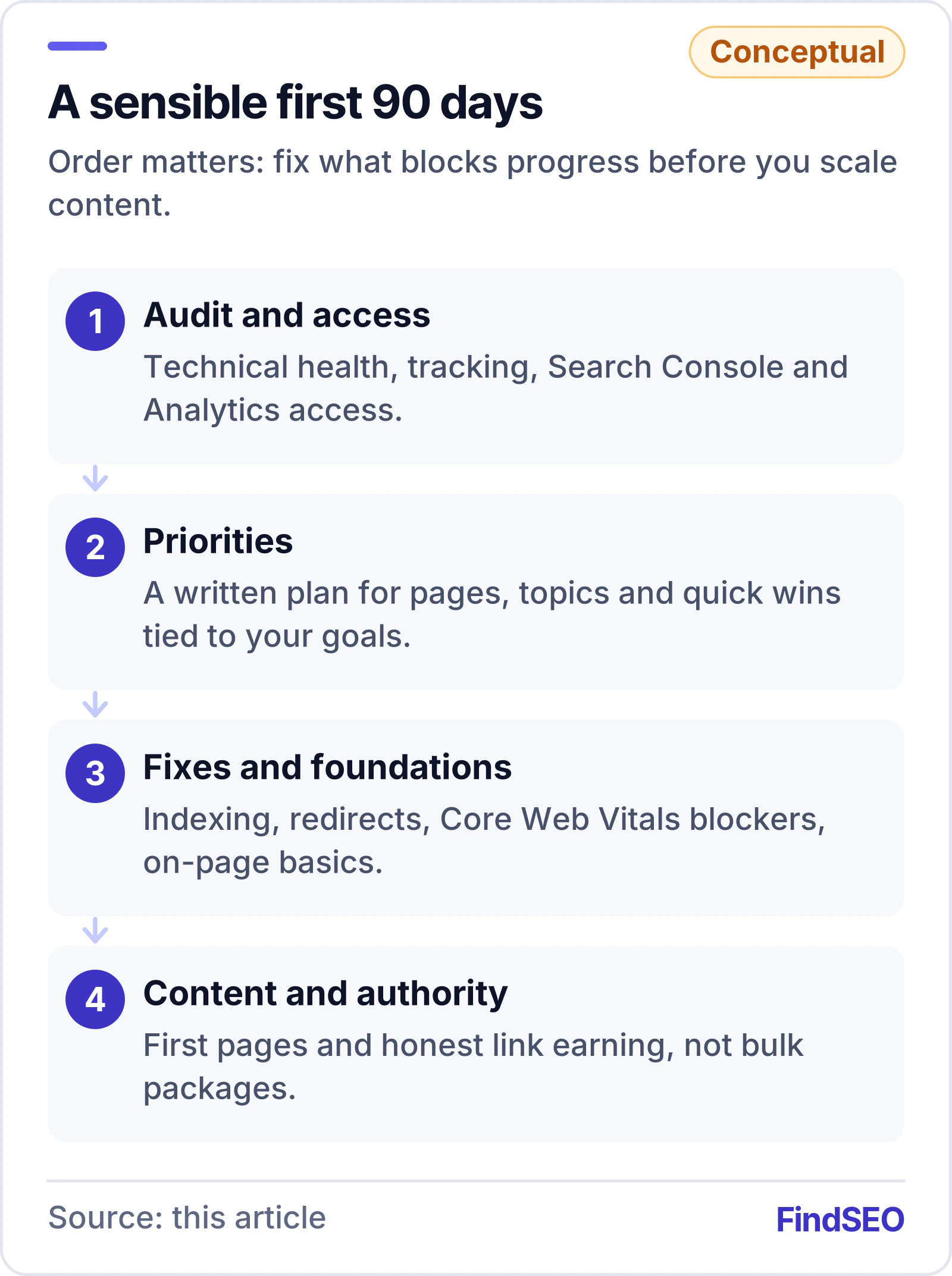
Four-step first 90 days for an SEO engagement: audit and access, then a written priorities plan, then foundation fixes such as indexing and Core Web Vitals blockers, then the start of content and honest link earning.
A competent agency can explain this order in plain language. Vague packages cannot.

Content and link building are where many problems hide, because bad tactics can put your site on the wrong side of Google's spam policies. Ask:

  1. How do you decide what content to create? Good answers start from search intent and what you can credibly say that competitors cannot. Be wary of a fixed blog quota with no link to your goals.
  2. Who writes the content, and how is accuracy checked? Subject experts from your business should be involved for technical or regulated topics.
  3. How do you earn links, and can you show examples? Ask where links come from and whether money changes hands for ranking credit. Buying or selling links that pass PageRank is link spam under Google's rules. Digital PR, useful assets and genuine partnerships are the honest end of the spectrum. Black hat SEO rarely appears in a pitch slide, so you have to ask.
  4. Will you ask us to link to your site? Google says plainly that you should never have to link to an SEO. A discreet credit is a request you can refuse.

If the answer to link earning is "500 backlinks a month" or "a private network", treat that as a hard stop. Our article on Google's spam policies explains why.

What should you ask about results, reporting and proof?

  1. What results do you expect, and in what timeframe? Google suggests this exact question. A good agency gives a range, states assumptions and is clear about uncertainty. It should not guarantee rankings. See how to spot fake SEO guarantees and how long SEO takes.
  2. How will you measure success? The best answers connect to enquiries, sales or other business outcomes from organic search. Rankings and traffic are useful leading indicators, not the goal. Our guide to measuring SEO ROI and the SEO ROI calculator help you frame that conversation.
  3. What will a monthly report contain? Ask to see a real (anonymised) example. Useful reports cover work done, results versus baseline, learnings and next steps — the structure in what an SEO report should include.
  4. Can you show previous work and put me in touch with clients? Google recommends checking business references. Case studies need dates, a starting point and business outcomes, which you can pressure-test with our reviews and case studies checklist. In Australia, the ACCC's online reviews guidance explains why fake or selectively published reviews are a problem; in the US, the FTC's rule on fake reviews bans bought and undisclosed testimonials.

If you need leads sooner than SEO can deliver, compare the timeline with SEO versus Google Ads.

What should you ask about access, ownership and the relationship?

  1. Who owns Search Console, Analytics, the Business Profile and the domain? You should. The agency gets user access. Google's help on Search Console permissions explains owners versus full and restricted users, and its hiring advice says read access is enough for an audit.
  2. What will you need from us each month? Slow approvals are a common reason SEO under-delivers. Ask for a realistic list: subject experts, content sign-off, developer time.
  3. How often do we meet, and who attends? Know whether you get the strategist or only an account manager reading a dashboard.
  4. What happens if we leave? You keep content, accounts and data. That answer must match the contract. Our Academy lesson on working with your agency and the guide to switching SEO agencies cover the handover.

Use the page authority checker and Google index checker as rough reads on an agency's own site or a case-study domain — never as proof on their own.

Overhead view of a person writing with a black pen on a sheet of white paper resting on a wooden desk.
Score each agency on the same checklist before you pick a favourite. Photo: Olu Eletu, CC0, via Wikimedia Commons.

What contract questions should you ask before you sign?

Turn the pitch answers into written commitments. Ask:

  1. What exactly is included each month? Hours, deliverables, pages or pieces of content — enough detail to check off.
  2. What is the minimum term, notice period and exit process? Including handover of files and removal of their access.
  3. Who owns the work product? Content, code changes and documentation created for you should be yours.
  4. How are scope changes and extra fees approved? No surprise invoices for "ongoing optimisation" that was never defined.
  5. Does the fee match the scope? Use the SEO cost calculator and Academy lesson on budgets and pricing models to sense-check quotes, then lock the promises into what an SEO contract should include.

A clear brief makes these answers better. Our lesson on writing an SEO brief and the guide to comparing SEO agency proposals help you line quotes up fairly.

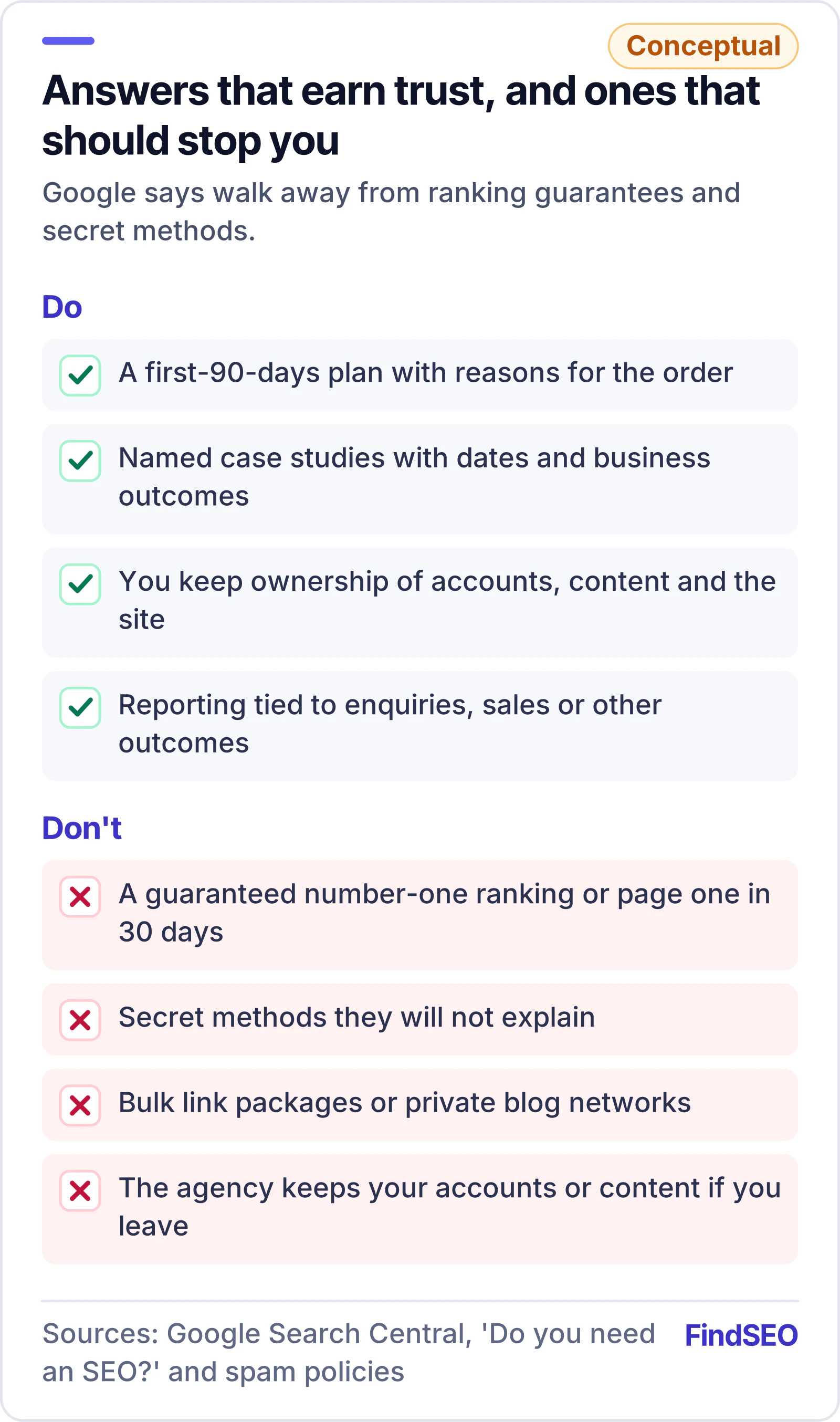
Do and don't list for SEO agency answers: do expect a reasoned first-90-days plan, named dated case studies, client-owned accounts and outcome-based reporting; don't accept ranking guarantees, secret methods, bulk link packages, or an agency that keeps your accounts or content if you leave.
If the pitch leans on guarantees or secrecy, walk away and shortlist someone else.

An interview checklist before you hire

Use the same score sheet for every agency:

  • They asked about your customers, goals and competitors before pitching tactics.
  • They described a first-90-days plan with reasons for the order.
  • The audit output is a prioritised plan, not only a tool export.
  • They follow Search Essentials and can explain how.
  • Link earning is described in plain language with examples you can check.
  • Success is defined with business outcomes and a realistic timeframe.
  • You saw a sample report that explains work, results and next steps.
  • Case studies are named or dated, and a reference is available.
  • You keep ownership of domain, site, content and Google accounts.
  • Scope, term, notice, exit and change-control are clear in writing.
  • Nobody promised a guaranteed ranking or a secret relationship with Google.
  • Price is compared on scope, using a shared brief.

When the shortlist is ready, get matched with agencies that fit your budget and market, or browse content SEO and technical SEO specialists.

The bottom line

Hiring an SEO agency is safer when you run one interview script across the shortlist. Ask about your business, the first 90 days, content and links, measurement, ownership and the contract. Google rules out ranking guarantees and puts the legal risk on you, so treat vague methods and bulk link offers as disqualifiers. Write the answers down, check the proof, then put the commitments in the contract. When you are ready to shortlist, use Get matched or the agency directory.

FAQs

How many SEO agencies should I talk to before hiring one?

Three is practical for most businesses. It is enough to compare approaches and prices without turning hiring into a second job. Ask every agency the same core questions so you can compare like with like.

Should an SEO agency guarantee rankings?

No. Google's hiring advice says no one can guarantee a number-one ranking on Google, and that if someone does, you should find someone else. An agency can commit to the work, the reporting and the process — not to a position it does not control.

What access should I give an agency before I sign?

Read-only access is enough at the pitch and audit stage. Google recommends granting only read access to Search Console during an audit. Give wider access once there is a contract, and keep ownership of every account yourself.

Is it a red flag if an agency will not explain how it builds links?

Yes. You are responsible for what is done on your behalf. An agency should say where links come from and how they are earned. Vague answers often hide paid or manipulative links that break Google's spam policies.

What is the most useful single question to ask?

Ask what they would do in the first 90 days and why in that order. A clear, reasoned sequence usually means they have diagnosed your situation. A generic package with no order usually means they have not.

Should the contract repeat the pitch promises?

Yes. Scope, deliverables, ownership of accounts and content, reporting, term, notice and exit should match what you were told in the meeting. If it is not in the contract, treat it as optional.

Sources

Ready for help with SEO?

Compare SEO-only agencies near you, with client reviews checked by a person, or tell us what you need and get matched.