Hiring an agency

SEO Agency Red Flags: 10 Warning Signs to Spot Before You Sign

The warning signs of a bad SEO agency, from ranking guarantees to paid links and owner-access requests, and the checks Google recommends before you hire.

FindSEO8 min read

A bright, empty meeting space with a tan leather sofa, two mustard-yellow armchairs with patterned cushions, a low wooden coffee table holding a potted plant, and pale geometric wall panels behind.

Photo: Dan Gold / Wikimedia Commons (CC0)

In this article
  1. Why do SEO red flags matter so much?
  2. What are the red flags in an SEO sales pitch?
  3. What are the red flags in an agency's methods?
  4. What are the red flags around access, reporting and contracts?
  5. How do you check an agency before you sign?
  6. What should you do if you've already hired a bad agency?
  7. SEO agency red flags checklist
  8. The bottom line

The biggest red flags in an SEO pitch are the ones Google warns about itself: a guarantee of a #1 ranking, a claimed "special relationship" with Google, a "priority submit" service, link schemes, secrecy about methods, and cold emails out of the blue. Others show up later: asking for owner access too early, reporting that hides what was done, and contracts that lock you in. None of these prove an agency is dishonest on their own, but each one should get a clear, written answer before you sign.

This guide walks through ten warning signs, what Google and Australian regulators say about each, and what a good agency does instead.

Why do SEO red flags matter so much?

Because the risk lands on you, not the agency. Google's guide Do you need an SEO? says hiring an SEO "can potentially improve your site's visibility and save you time, but you can also risk damage to your site and reputation." It goes further: "Ultimately, you are responsible for the actions of any companies you hire."

If an agency uses tactics that break Google's spam policies, Google says sites "may rank lower in results or not appear in results at all." Google can also apply a manual action after human review, which shows up in the Manual actions report in Search Console. Cleaning that up costs time you were paying the agency to save.
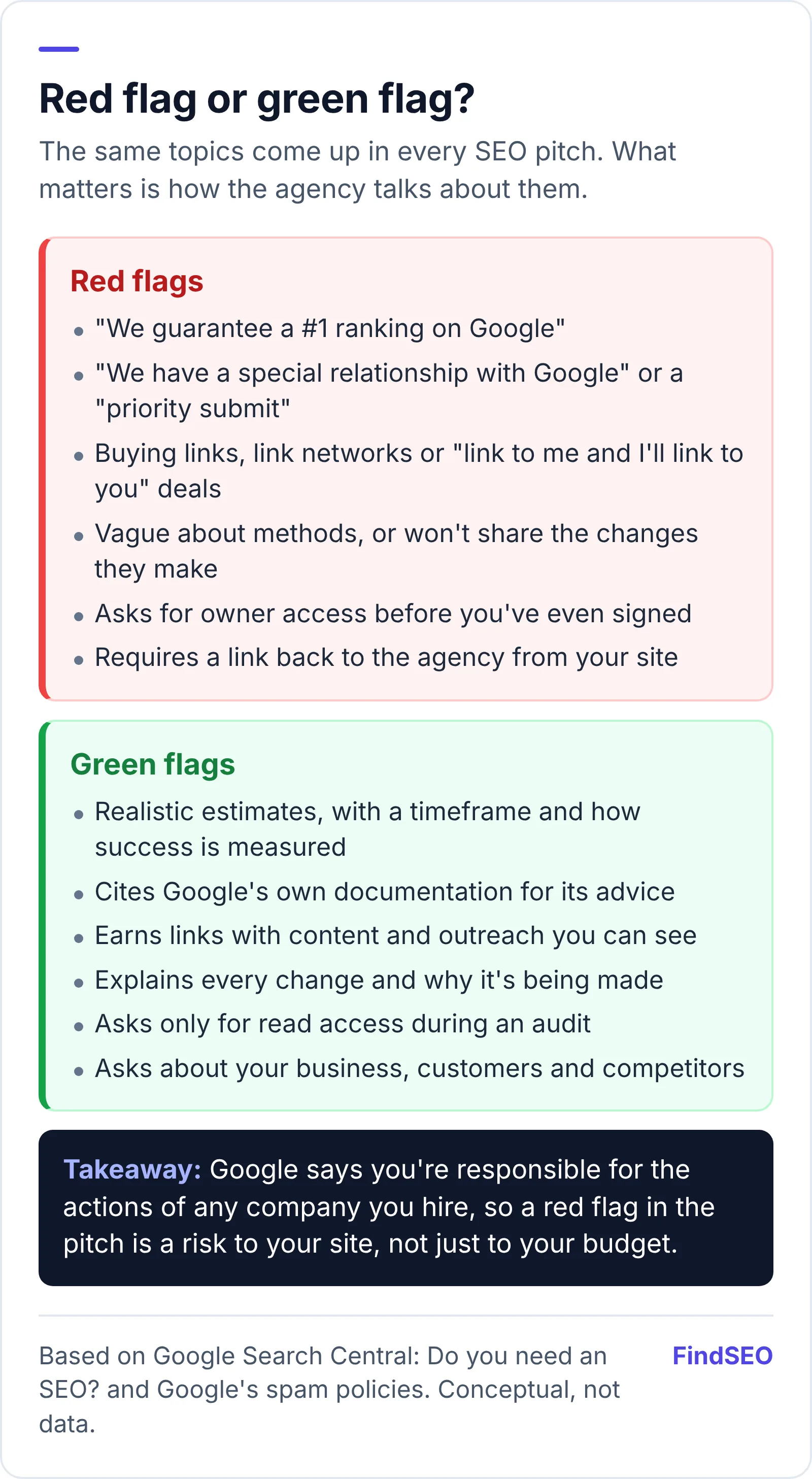
Comparison graphic of SEO agency red flags and green flags. Red flags: guaranteeing a number one ranking on Google; claiming a special relationship with Google or a priority submit; buying links, link networks or link-to-me-and-I'll-link-to-you deals; being vague about methods or not sharing the changes they make; asking for owner access before you have signed; and requiring a link back to the agency from your site. Green flags: realistic estimates with a timeframe and how success is measured; citing Google's own documentation; earning links with content and outreach you can see; explaining every change and why; asking only for read access during an audit; and asking about your business, customers and competitors. Takeaway: Google says you are responsible for the actions of any company you hire.
The same topics come up in every pitch. How the agency answers them is what separates a red flag from a green one. Based on Google Search Central: Do you need an SEO? and Google's spam policies.

What are the red flags in an SEO sales pitch?

These four come straight from Google's hiring guidance, and they're the easiest to spot in a first meeting or proposal.

1. A guarantee of a #1 ranking

Google is direct: "No one can guarantee a #1 ranking on Google." It adds that if an SEO audit comes with a guarantee that the changes "will give you first place in search results, find someone else." Agencies can set targets and estimate outcomes. They can't promise positions, because they don't control Google's ranking systems. Our guide to fake SEO guarantees covers the wording to watch for, such as "page one or your money back".

In Australia, the ACCC's guidance on false or misleading claims says a business must be able to prove any claim it advertises, and that claims about the future need reasonable grounds at the time they're made.

2. A "special relationship" with Google

Google tells buyers to beware of SEOs that "allege a 'special relationship' with Google". It also says advertising with Google "won't have any effect on your site's presence in our search results" and that Google "never accepts money to include or rank sites". A Google Partner badge doesn't change that: Google's page on how to become a Google Partner bases the badge on Google Ads performance, spend and certifications, not organic search.

3. "Priority submit" or submitting to thousands of search engines

Google names "priority submit" offers as a warning sign, and says pitches about "submitting your site to thousands of search engines" are "typically useless exercises". You can submit a sitemap yourself, free, in Google Search Console. Our guide to setting up Google Search Console shows how.

4. An email out of the blue

Google says to be wary of SEO firms "that email you out of the blue", and compares the right level of scepticism to spam about "burn fat at night" diet pills. A cold pitch isn't proof of a bad agency, but an unsolicited "audit" claiming your site isn't listed in search engines usually is.


A woman with long dark hair holds a phone to her ear and looks to the side with a serious, uncertain expression, against a blurred background of passers-by.
Unsolicited SEO calls and emails are one of the warning signs Google names in its own hiring advice. Photo: Ehimetalor Unuabona, CC0, via Wikimedia Commons.

What are the red flags in an agency's methods?

The next three only show up when you ask how the work gets done. Ask anyway, because Google says you should "be careful if a company is secretive or won't clearly explain what they intend to do."

5. Links that are bought, swapped or automated

Google's spam policies define link spam as creating links "primarily for the purpose of manipulating search rankings". The examples include exchanging money, goods or services for links, "excessive link exchanges", and "using automated programs or services to create links to your site". If a proposal promises a set number of backlinks a month without saying where they come from, ask for examples. Our link building glossary entry and our article on whether link building is worth it explain what legitimate link earning looks like.

6. A required link back to the agency

Google says: "You should never have to link to an SEO." Its spam policies also list "requiring a link as part of a Terms of Service, contract, or similar arrangement" as link spam when the site owner can't qualify the link. A small credit in your footer is a decision for you, not a condition of the contract, and Google's guide to qualifying outbound links explains how to mark one.

7. Content at scale with nothing behind it

Google's spam policies describe scaled content abuse as "many pages are generated for the primary purpose of manipulating search rankings and not helping users", "no matter how it's created". Hundreds of near-identical suburb pages are a warning sign, and so are blocks of text listing cities and regions, which Google gives as an example of keyword stuffing. Our guides to Google's helpful content self-assessment and location pages for local SEO show where the line sits.

What are the red flags around access, reporting and contracts?

These appear once you're close to signing, or just after.

8. Asking for owner access too early

For an audit, Google says to "only grant read access to Search Console (at this stage, don't grant them write access)." Search Console Help on managing owners, users and permissions explains that owners have full control, including adding and removing users, while restricted users have simple view rights on most data. Keep your business as the owner of every account. Our guide to giving an SEO agency access safely covers each platform.

9. Reports that show activity, not results

Google suggests asking: "What kind of results do you expect to see, and in what timeframe? How do you measure your success?" A good answer ties work to the goals you agreed. A red flag is a monthly PDF of rankings for terms nobody searches, with no list of what was changed. Our guide to what an SEO report should include sets out what to expect, and the SEO goals and KPIs lesson helps you set targets up front.

10. Contracts that lock you in or keep your assets

Watch for long minimum terms with no performance review, vague deliverables, and clauses that leave the agency owning your content, accounts or domain. Our guide to what an SEO contract should include lists the clauses to check, and the free SEO contract template gives you a starting point.

An open laptop on a light pine desk beside a cup of black coffee, two yellow pencils, a pad of sticky notes and a few crumpled balls of paper.
Read every proposal slowly, and check each claim against Google's own documentation before you sign. Photo: Lauren Mancke, CC0, via Wikimedia Commons.

How do you check an agency before you sign?

Run every shortlisted agency through the same five checks. The table pairs each red flag with what to ask instead.

Red flag What Google or the regulator says What to ask instead
Guaranteed #1 ranking No one can guarantee a #1 ranking What results do you expect, by when, and how will we measure them?
Special relationship with Google Google never accepts money to rank sites Which Google documentation supports this plan?
Bought or swapped links Link spam can lower rankings or remove a site Can you show three links you earned and how?
Owner access for an audit Give read access only at the audit stage What's the lowest access level you need?
Vague methods Be careful if a company is secretive Will you share every change you make and why?
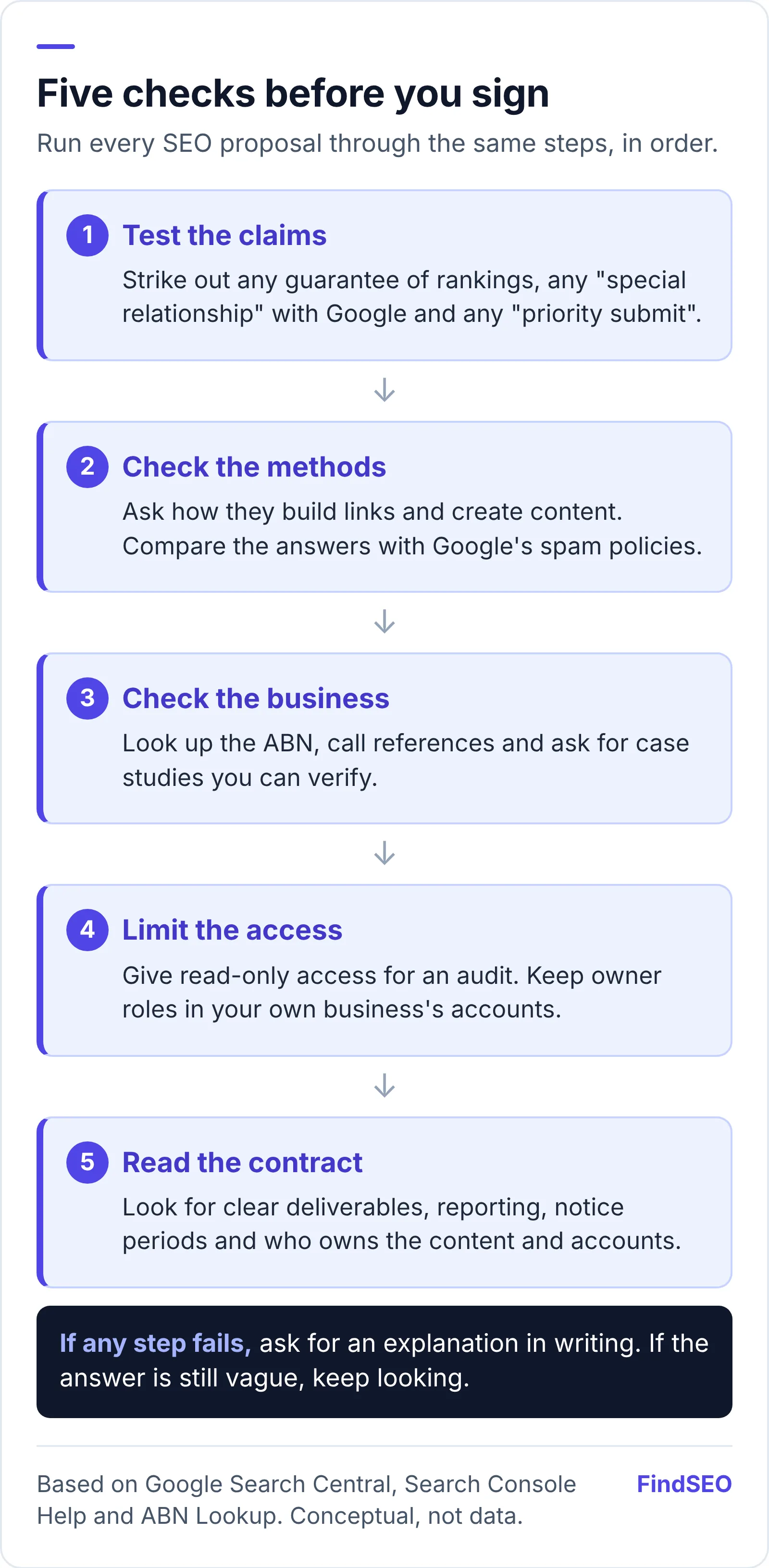
Five-step flowchart for vetting an SEO agency before you sign. Step one, test the claims: strike out any guarantee of rankings, special relationship with Google or priority submit. Step two, check the methods: ask how they build links and create content and compare the answers with Google's spam policies. Step three, check the business: look up the ABN, call references and ask for case studies you can verify. Step four, limit the access: give read-only access for an audit and keep owner roles in your own business's accounts. Step five, read the contract: look for clear deliverables, reporting, notice periods and who owns the content and accounts. If any step fails, ask for an explanation in writing, and keep looking if the answer is still vague.
Five checks, in order, catch most red flags before they cost you anything. Based on Google Search Central, Search Console Help and ABN Lookup.

For step three, you can confirm an Australian agency's registered business details on ABN Lookup. Our guide to checking SEO agency reviews and case studies explains how to verify results you can't see directly, and our list of questions to ask an SEO agency gives you the interview script. The Academy lesson on evaluating proposals and red flags goes deeper on comparing quotes side by side.

What should you do if you've already hired a bad agency?

Act early. In order:

  1. Secure your accounts. Remove the agency's access in Search Console, Google Analytics, your website and your domain registrar. Search Console Help says to also delete any unused ownership verification tokens, or a removed owner can re-verify.
  2. Check for damage. Look at the Manual actions report and the Performance report in Search Console, and ask for a full list of changes and links built. An independent SEO audit can help if the list is missing.
  3. Fix what broke the rules. Google's spam policies explain what to remove. If you received a manual action, the report explains how to request a review once it's fixed.
  4. Report deception if needed. Google's guide points US buyers to the FTC, and buyers in other countries to econsumer.gov. In Australia, the ACCC accepts reports about misleading claims.

When you're ready to move on, our guide to switching SEO agencies covers the handover.

SEO agency red flags checklist

  • No guarantee of rankings, positions or "page one" results.
  • No claim of a special relationship with Google, or a "priority submit".
  • The agency explains how it earns links, with examples you can check.
  • No requirement to link back to the agency from your site.
  • Content plans are built around real pages for real customers, not volume.
  • Only read access was requested for the audit.
  • Your business stays the owner of Search Console, Analytics, the site and the domain.
  • Reporting ties work done to goals you agreed.
  • The contract names deliverables, notice periods and who owns the work.
  • You've checked the ABN, called references and verified a case study.

The bottom line

Google's own guide says many SEOs provide useful services, and that a good one can help a new or existing site. The bad ones tend to give themselves away early: guarantees, secret methods, bought links and requests for more access than the job needs. Ask for everything in writing, check it against Google's documentation, and keep ownership of your accounts. Before you talk to anyone, the free SEO ROI calculator helps you work out what results are worth, and the page authority checker gives you a baseline. Then browse vetted SEO agencies in Australia, or get matched with agencies that fit your brief.

FAQs

Is it a red flag if an SEO agency guarantees first-page rankings?

Yes. Google says no one can guarantee a #1 ranking on Google, and that if an SEO guarantees its changes will give you first place in search results, you should find someone else. Agencies can set targets and estimates, but they don't control Google's rankings.

Can an SEO agency have a special relationship with Google?

Not for organic rankings. Google says it never accepts money to include or rank sites in its search results, and that advertising with Google won't affect your organic presence. A Google Partner badge relates to Google Ads, not SEO.

What access should I give an SEO agency for an audit?

Google recommends read access to Search Console only at the audit stage, not write access. Keep your business as the owner of Search Console, Google Analytics, your website and your domain, and give the agency the lowest role that covers the work.

Is buying backlinks a red flag?

Yes. Google's spam policies list buying or selling links for ranking purposes, excessive link exchanges and automated link building as link spam. Sites that break the spam policies may rank lower or not appear in results at all.

What should I do if my SEO agency used spammy tactics?

Remove the agency's access, including unused Search Console verification tokens, check the Manual actions report, ask for a full list of changes and links, and fix anything that breaks Google's spam policies. If you received a manual action, request a review once it's fixed.

Sources

Ready for help with SEO?

Compare SEO-only agencies near you, with client reviews checked by a person, or tell us what you need and get matched.