
SEO strategy

Is Link Building Still Worth It? What Google Says About Backlinks

Links still help Google judge useful pages, but bought links are spam. What Google rewards, what it ignores and how to judge a link-building pitch.

FindSEO7 min read

A rusted iron safety chain stretched diagonally across the frame, its oval links in sharp focus against a blurred blue sea and sandy shore.

Photo: Guillaume Paumier / Wikimedia Commons (CC BY-SA 3.0)

In this article
  1. Do backlinks still matter to Google?
  2. What counts as link spam?
  3. What happens if you buy links anyway?
  4. Which rel attribute should a link use?
  5. Do you need to disavow bad links?
  6. What does good link building look like?
  7. How do you judge a link-building proposal?
  8. A link-building checklist
  9. The bottom line

Yes, if you mean earning links. Google says links are one of the ways it understands which content may be helpful to searchers, and that they're good for sites to receive "as long as they're well deserved". Its link analysis systems, including PageRank, are still part of its core ranking systems. What isn't worth paying for is link building that manipulates rankings: buying links, swapping them at scale or planting them with automated tools. Google treats that as link spam, works to cancel out its effect, and can hit a site with a manual action. The value is in links people choose to give you.

This guide explains what Google has said about backlinks, where the line sits between link building and link spam, when you need to worry about bad links, and how to judge an agency's link-building proposal before you sign.

They do, but they're one signal among many. Google's guide to its ranking systems says it has various systems that look at how pages link to each other to work out what pages are about and which might be most helpful for a query. PageRank, one of the core systems Google launched with, has "evolved a lot" since then and is still part of its core ranking systems.

Google's public explainer on how it ranks results gives one example of a quality factor: whether other prominent websites link to or refer to the content, which it describes as generally a good sign the information is trustworthy.

There are limits. Google's SEO Starter Guide lists PageRank among things not to over-focus on: it uses links and is a fundamental algorithm, but "there's much more to Google Search than just links", and PageRank is one of many ranking signals. A page with lots of backlinks still has to be relevant and helpful to rank.

Links also help with discovery. The same guide says the vast majority of new pages Google finds every day are found through links, which is why internal linking matters as much as links from other sites.

Google's spam policies define link spam as creating links to or from a site primarily to manipulate search rankings. Its examples include:

  1. Buying or selling links for ranking purposes, including paying money, swapping goods or services, or sending someone a free product in exchange for a post with a link.
  2. Excessive link exchanges ("link to me and I'll link to you") or partner pages that exist only to cross-link.
  3. Using automated programs or services to create links to your site.
  4. Requiring a link in a contract or terms of service without letting the other site qualify it.
  5. Advertorials and paid articles whose links pass ranking credit, and links with optimised anchor text in articles, guest posts or press releases distributed on other sites.
  6. Low-quality directory or bookmark site links, links hidden in widgets, links in footers or templates across many sites, and forum comments stuffed with keyword links.
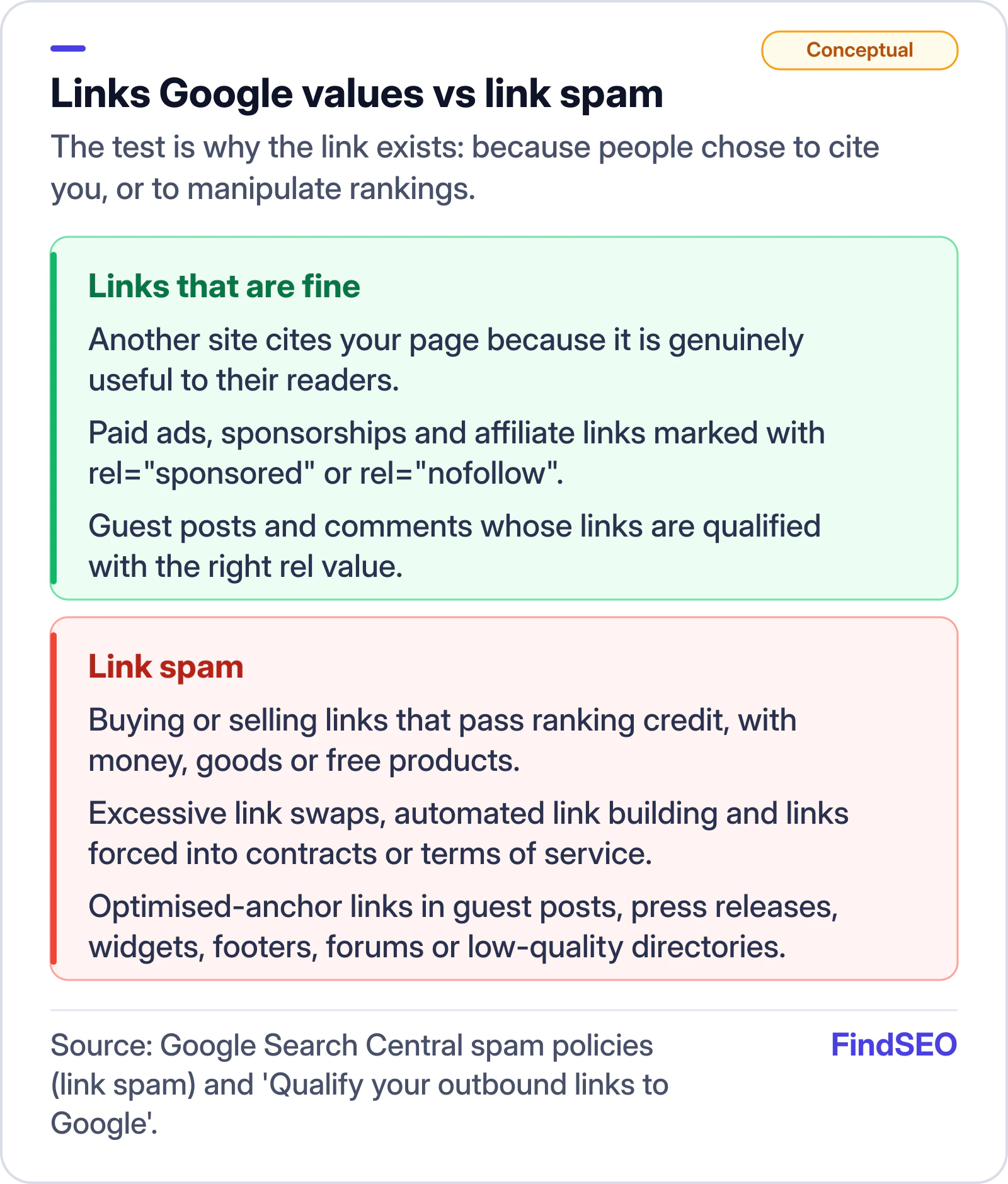
Comparison of links Google values and link spam. Links that are fine: another site cites your page because it is genuinely useful to its readers; paid ads, sponsorships and affiliate links marked with rel sponsored or rel nofollow; and guest posts and comments whose links are qualified with the right rel value. Link spam: buying or selling links that pass ranking credit with money, goods or free products; excessive link swaps, automated link building and links forced into contracts or terms of service; and optimised-anchor links in guest posts, press releases, widgets, footers, forums or low-quality directories. Source: Google Search Central spam policies and Qualify your outbound links to Google.
Paying for a link isn't the problem in itself. Paying for one that passes ranking credit is.

Paid links aren't banned outright. Google says buying and selling links is a normal part of the web's advertising and sponsorship economy, and it isn't a breach of its policies as long as those links are marked with rel="nofollow" or rel="sponsored". Our overview of Google's spam policies covers the other behaviours that get sites demoted.

At best, you've wasted the money. In its December 2022 link spam update, Google said its spam-prevention system, SpamBrain, can detect both sites buying links and sites used to pass outgoing links. It said rankings may change "as spammy links are neutralized", and any credit those unnatural links passed is lost.

A heap of tangled, heavily rusted chain links piled on top of each other, flaking orange and brown in bright sunlight.
Bought links tend to leave a tangle someone has to sort out later. Photo: shuraki, CC0, via Wikimedia Commons.

At worst, a person at Google reviews your site. Search Console's manual actions report includes an "Unnatural links to your site" action for a pattern of artificial, deceptive or manipulative links, and Google says this can affect some or all of a site. Google's 2021 reminder on qualifying links adds that sites publishing or acquiring links through excessive sponsored and guest posts without the proper link tags can face algorithmic and manual actions, as can sites that don't qualify affiliate links.

That's why link schemes are a common red flag in our guide to questions to ask an SEO agency. If an agency built bad links for you in the past, it's also something to clean up when you switch SEO agencies.

Google's guide to qualifying outbound links sets out three values for the rel attribute on a link:

rel value Use it for Google's guidance
sponsored Ads, paid placements and sponsorships Preferred for paid links. nofollow is still acceptable
ugc User-generated content such as comments and forum posts Can be removed for trusted, long-standing contributors
nofollow Other links you don't want associated with your site Use when the other values don't apply

Google says you can combine values, for example rel="ugc nofollow". If your business sponsors an event, sells ads on its own site or runs an affiliate program, the nofollow and sponsored values are what keep those links within the rules.

Probably not. Search Console Help's page on disavowing links says that in most cases Google can assess which links to trust without extra guidance, so most sites won't need the tool. It says to disavow only if you have a considerable number of spammy, artificial or low-quality links, and they have caused, or are likely to cause, a manual action.

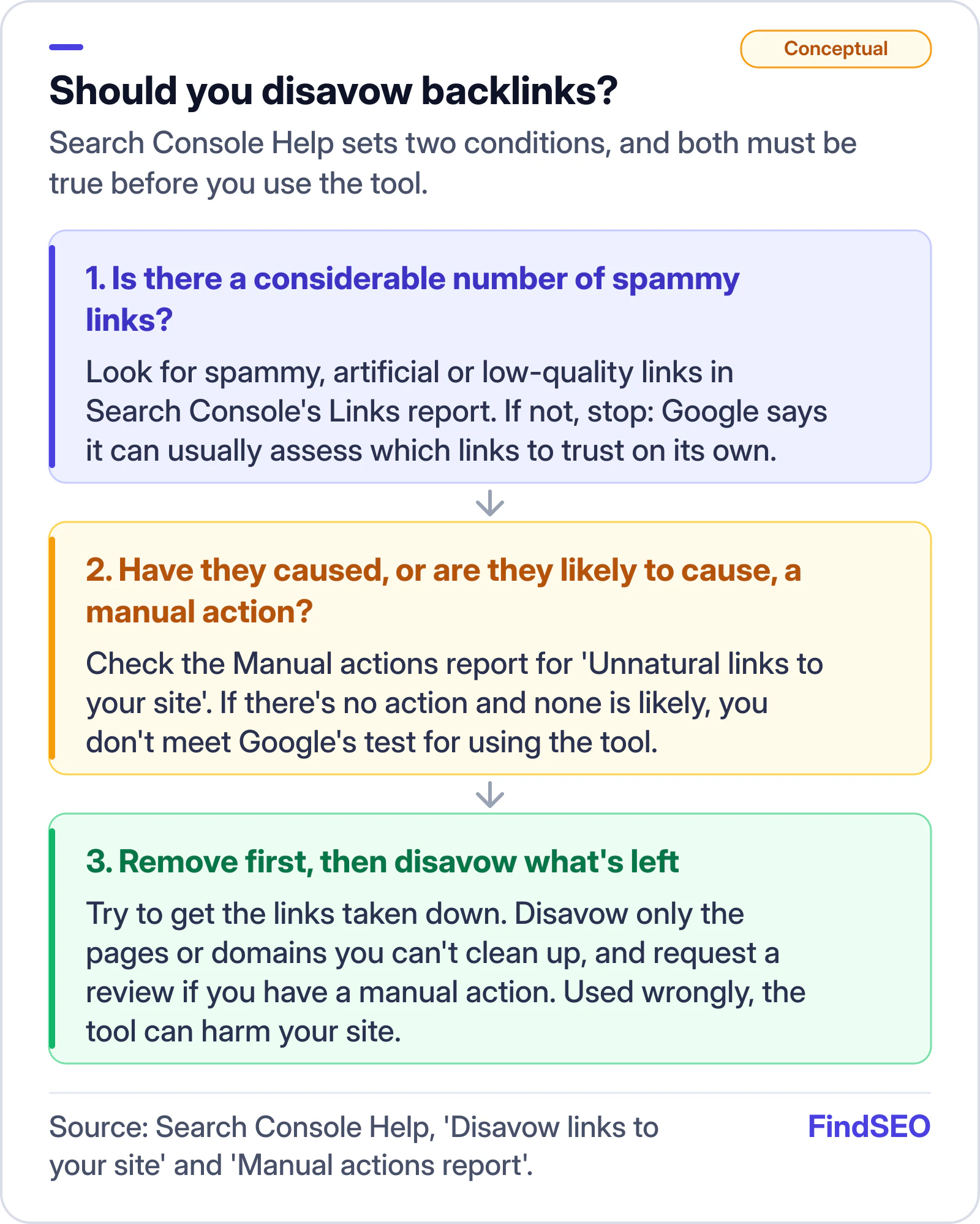
Three-step check for whether to disavow backlinks, from Search Console Help. One: is there a considerable number of spammy, artificial or low-quality links in the Links report? If not, stop, because Google can usually assess which links to trust. Two: have they caused, or are they likely to cause, an Unnatural links manual action? If not, you don't meet Google's test for using the tool. Three: try to get the links removed first, disavow only what you can't clean up and request a review if you have a manual action, because the tool can harm a site if used wrongly. Source: Search Console Help.
Both conditions have to be true before disavowing makes sense.

Google calls disavowing an advanced feature to use with caution, because used incorrectly it can harm your site's performance. Treat a pitch for a routine "toxic link clean-up" with some scepticism if there's no manual action and no history of bought links. Search Console's Links report, part of Google Search Console, shows a sample of the sites linking to you, which is a free place to start.

It looks like marketing that gives people a reason to mention you. The SEO Starter Guide recommends promoting new content through social media, community engagement, advertising and word of mouth, which it calls one of the most effective and lasting ways. It also suggests offline promotion, such as putting your URL on business cards and other printed materials.

In practice, ethical link building usually means:

  1. Publishing something worth citing, such as original research, a useful tool, a clear guide or expert commentary.
  2. Telling the right people about it, such as journalists, industry bodies, suppliers and community groups.
  3. Earning mentions from real relationships, like sponsorships, partnerships and local events, with paid links marked as sponsored.
  4. Studying where competitors get links, then creating something better for those audiences. Our Academy lesson on competitor and gap research shows how.

Ask how the links will be earned, not just how many you'll get. A few questions to put to any agency:

  1. Will you pay any site for a link? If so, will that link be marked sponsored or nofollow?
  2. Which sites will you target, and why are they relevant to my customers?
  3. What anchor text will you use? Google lists optimised anchors in guest posts and press releases as link spam.
  4. Will every link appear in my monthly report? Our checklist on what an SEO report should include covers what to expect.
  5. What happens to the links if we stop working together? Get the answer written into your SEO contract.

Be wary of promises like "50 high-DA links a month". Domain Authority and similar scores are third-party estimates, not Google metrics. Use our free page authority checker to sense-check the sites on offer, and the SEO ROI calculator to see whether the fee stacks up. Guaranteed links or rankings are a warning sign, as our guide to fake SEO guarantees explains.

  • Focus on earning links from sites your customers actually read.
  • Mark every paid, sponsored or affiliate link with rel="sponsored" (or nofollow).
  • Mark comment and forum links on your own site with rel="ugc".
  • Never buy links that pass ranking credit, or swap links at scale.
  • Avoid keyword-stuffed anchors in guest posts, press releases and widgets.
  • Don't use automated link-building tools or services.
  • Ask for a full list of every link an agency builds for you.
  • Check Search Console's Links report and Manual actions report a few times a year.
  • Only disavow if you have many spammy links and a manual action, or one is likely.

The bottom line

Link building is still worth it when it means earning links that people choose to give. Google still uses links to understand which pages are useful, but it works to cancel out the effect of links built to manipulate rankings, and can take manual action against sites that buy them. Spend on content, research and relationships that deserve a mention, and mark anything paid as sponsored. Our Academy lesson on Search Essentials and spam policies goes deeper on the rules. When you're ready for help, compare link building agencies in Australia, read what link building services include, browse SEO agencies in Melbourne, or get matched with an agency that can show you exactly how it earns links.

FAQs

Are backlinks still a Google ranking factor?

Yes. Google says its link analysis systems, including PageRank, are part of its core ranking systems and help it understand what pages are about and which might be most helpful. It also says there's much more to Search than links, and PageRank is one of many signals.

Is it against Google's rules to pay for links?

Only if the links pass ranking credit. Google says buying and selling links for advertising and sponsorship is normal, as long as the links are marked with rel="sponsored" or rel="nofollow". Paid links that aren't marked are link spam.

Are guest posts bad for SEO?

Not in themselves. Google says guest posts primarily intended to gain links are a problem, and recommends that links in sponsored and guest posts use the appropriate rel value. Optimised anchor text links in guest posts are listed in its link spam examples.

Should I disavow spammy links pointing to my site?

Usually not. Google says most sites won't need the disavow tool. Use it only if you have a considerable number of spammy, artificial or low-quality links and they have caused, or are likely to cause, a manual action.

Does Google use Domain Authority?

No. Domain Authority is a score from Moz, and similar scores come from other SEO tools. They're third-party estimates based mainly on links, not metrics Google uses to rank pages.

Sources

Ready for help with SEO?

Compare SEO-only agencies near you, with client reviews checked by a person, or tell us what you need and get matched.