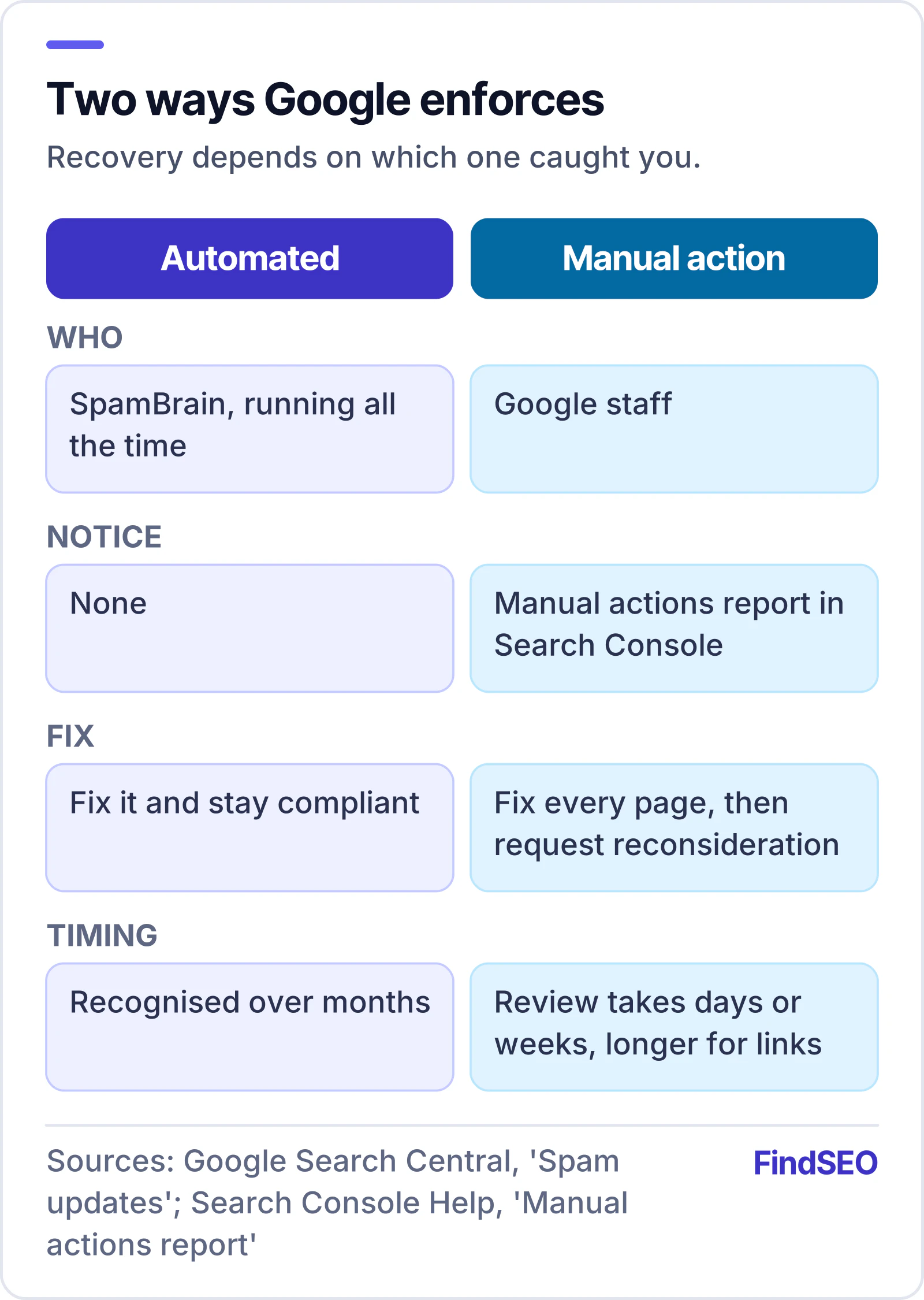
Google's spam policies are the rules that decide which tactics can get a website pushed down or removed from Google Search. Google says sites that break them "may rank lower in results or not appear in results at all", and it finds violations with automated systems and with manual review by Google staff, which can lead to a manual action. For a business owner, the practical point is simple: any SEO work done for you has to stay inside these rules, because your site carries the risk, not the agency.
This guide explains what the policies cover, the three newer rules Google added in 2024, the tactics that most often get businesses into trouble, and what recovery actually looks like.

What are Google's spam policies?
Google publishes its spam policies for web search as part of Google Search Essentials. They describe practices Google treats as attempts to deceive users or manipulate its rankings. The current list includes:
- Cloaking, which shows Google different content from what people see.
- Doorway abuse, such as many near-identical pages built to rank for slight variations of a search.
- Expired domain abuse.
- Hacked content, hidden text and hidden links.
- Keyword stuffing.
- Link spam.
- Machine-generated traffic, malicious practices and misleading functionality.
- Scaled content abuse.
- Scraping, meaning republishing other sites' content without adding value.
- The site reputation policy.
- Sneaky redirects, thin affiliation and user-generated spam.
The page also covers legal removals, scams and fraud, and policy circumvention. Our Academy lesson on Search Essentials and spam policies walks through the basics if you're new to them.
What changed in 2024?
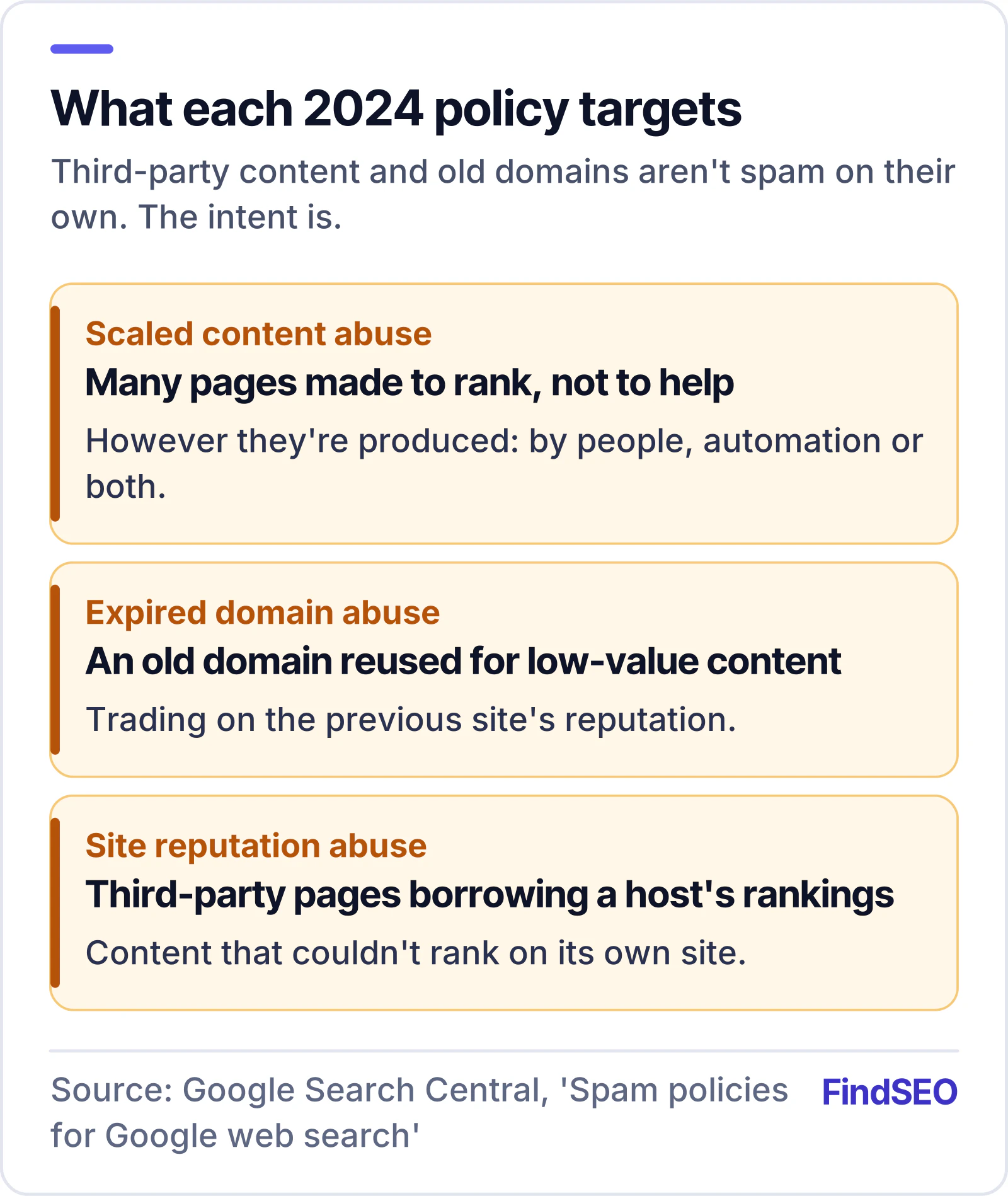
In March 2024, Google announced three new spam policies alongside that month's core update. They target tactics that had grown common in the SEO industry.

Scaled content abuse
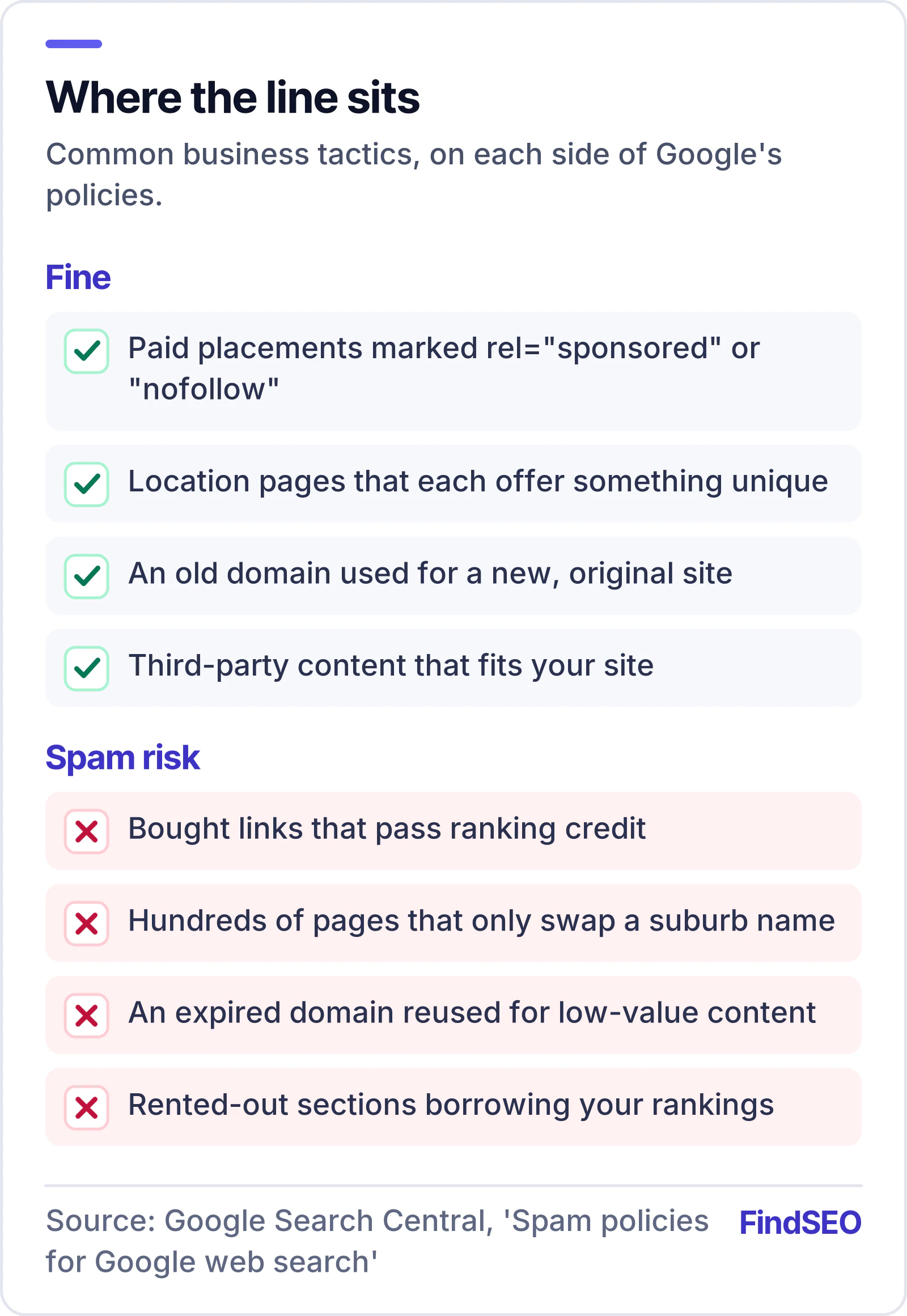
This is publishing many pages mainly to manipulate rankings rather than to help people. Google's policy applies "no matter how it's created", and its announcement said it covers content produced at scale "whether automation or humans are involved." In other words, a writing team churning out hundreds of thin location pages is treated the same way as a content-generation tool doing it. Our helpful content self-assessment is a useful test of whether a page earns its place.
Expired domain abuse
This is buying an expired domain and reusing it to host low-value content that trades on the old site's reputation. Google's example is casino content on a domain that used to belong to an elementary school. Google also says "it's fine to use an old domain name for a new, original site", so buying a domain isn't the problem. Using its history to rank unrelated content is.
Site reputation abuse
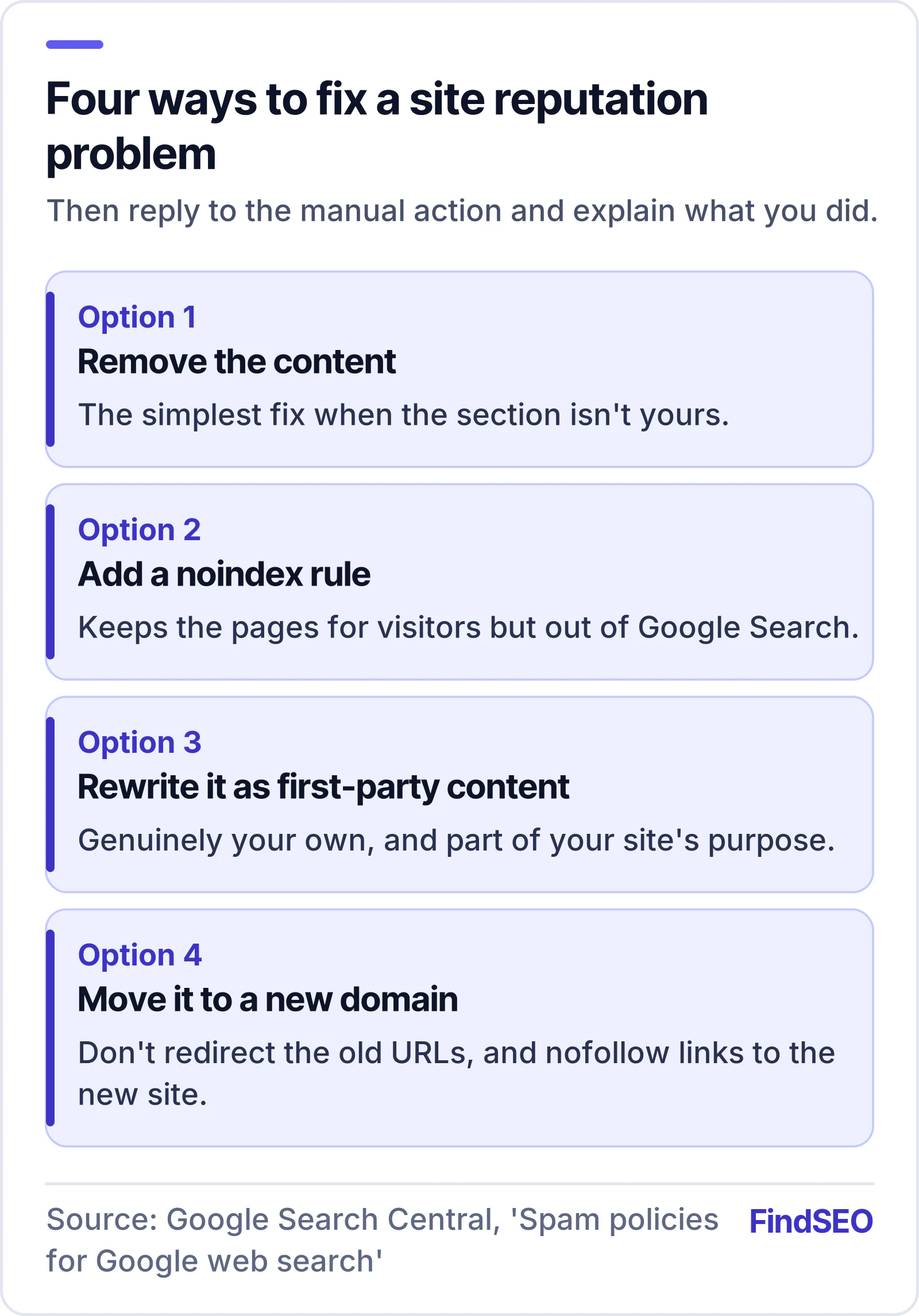
This is publishing third-party pages on an established site to take advantage of that site's ranking signals. The policy took effect on 5 May 2024. In November 2024, Google clarified the policy to say it applies "regardless of whether there is first-party involvement or oversight of the content." Google also stresses that third-party content alone isn't a violation. Freelance articles, properly marked affiliate links and guest content can all be fine. The problem is using a host site's reputation to rank content that couldn't rank on its own. Google's policy page now calls this the site reputation policy, and notes that in the European Economic Area such pages are categorised separately rather than given a manual action. Our guide to site reputation abuse explains that change and what Google checks when it reviews a site section.