FindSEO
Industry news

Google's Ranking Systems Explained: What Each One Actually Does

Google publishes a list of the ranking systems behind its results. Here's what each one does, which ones are retired, and which ones your site can influence.

FindSEO8 min read

Close-up of a sound mixing desk with rows of white faders and coloured knobs, each adjusting a different channel

Photo: Alexey Ruban / Wikimedia Commons (CC0)

In this article
  1. What are Google's ranking systems?
  2. Which systems help Google understand a search?
  3. Which systems judge quality and reliability?
  4. Which systems shape the results page?
  5. Which systems demote sites?
  6. Which systems has Google retired?
  7. What can a business actually influence?
  8. A ranking systems checklist for site owners
  9. The bottom line

Google doesn't rank pages with one algorithm. It uses a set of automated ranking systems, each with its own job: understanding what a search means, judging which pages are reliable and original, keeping the results page varied, and demoting spam. Google names its more notable systems in a public guide. Most of them reward the same things: pages that clearly answer the search, are original and trustworthy, and don't break Google's spam policies.

That guide is the most useful primary source on the topic. Much of what's written elsewhere about "the algorithm" is guesswork. This article goes through the systems Google itself lists, explains what each one does in plain English, and shows which ones a business or its agency can actually influence.

What are Google's ranking systems?

Google's guide to its ranking systems says its automated systems look at many factors and signals about hundreds of billions of web pages and other content in its index, and return results in a fraction of a second. Some systems are part of what Google calls its core ranking systems, the underlying technology that produces results. Others handle specific needs, such as crisis information or local news.

Two details from the guide matter for site owners:

  1. Ranking works at the page level. Google uses signals and systems to understand how to rank individual pages.
  2. Site-wide signals also count. Google says site-wide signals and classifiers contribute too, but good ones don't mean every page ranks well, and poor ones don't mean every page ranks badly.
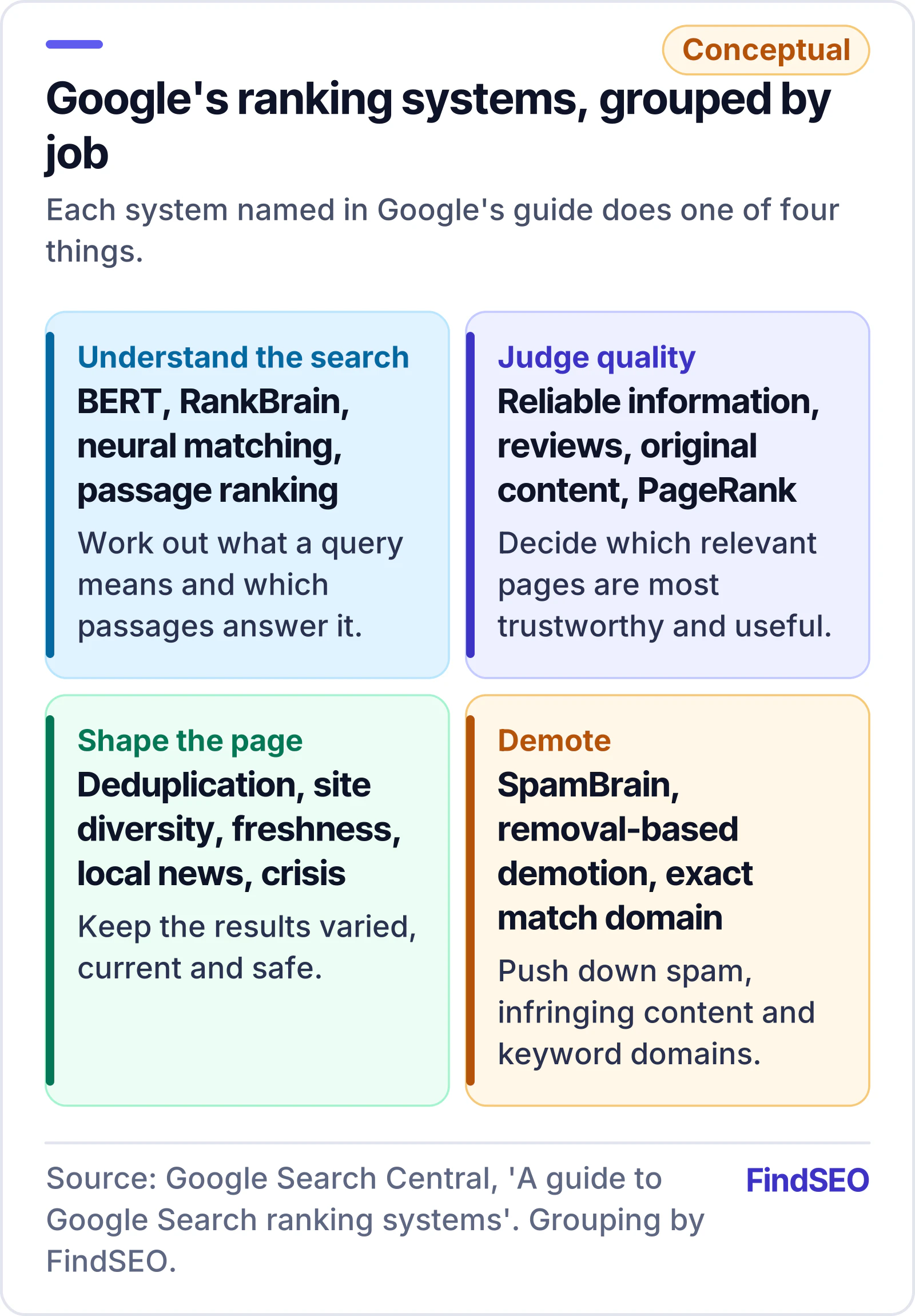
Diagram grouping Google's named ranking systems into four jobs: understanding the search (BERT, RankBrain, neural matching, passage ranking), judging quality (reliable information, reviews, original content, PageRank), shaping the results page (deduplication, site diversity, freshness, local news, crisis information) and demoting (SpamBrain, removal-based demotion, exact match domain).
Four jobs, many systems. No single one decides a ranking.

Google's How Search Works overview of ranking adds the broader picture. Google's algorithms weigh the words of your query, the relevance and usability of pages, the expertise of sources and your location and settings, and the weight of each factor depends on the kind of search. Google also says it runs hundreds of thousands of experiments every year to improve Search. If you want the basics of crawling and indexing first, our Academy lesson on how search engines crawl, index and rank covers them.

Several of the listed systems are machine-learning language systems. Their job is to work out what someone means, not just which words they typed:

  1. BERT helps Google understand how combinations of words express different meanings and intent.
  2. RankBrain helps Google understand how words relate to concepts, so it can return relevant pages even when they don't contain every word in the search.
  3. Neural matching matches representations of concepts in queries and pages to each other.
  4. Passage ranking identifies individual sections, or passages, of a page to judge how relevant the page is to a search.
  5. MUM can understand and generate language, but Google says it isn't currently used for general ranking. It's used for specific applications, such as COVID-19 vaccine searches and featured snippet callouts.

The practical takeaway is that exact-match keyword stuffing has little to offer. Pages do well when they meet the search intent behind a query and use clear headings, so a relevant passage is easy to find. Our lesson on headings and content structure shows how.

Rows of colourful books on tall grey library shelves, with the far end of the aisle softly out of focus.
Language systems work like a good librarian: they find the right book even when you don't know its exact title. Photo: Jamie Taylor, CC0, via Wikimedia Commons.

Which systems judge quality and reliability?

A second group decides which relevant pages deserve to rank highest:

  1. Reliable information systems surface more authoritative pages, demote low-quality content and elevate quality journalism. When reliable information is lacking, Google can show a content advisory instead.
  2. The reviews system rewards high-quality reviews: insightful analysis and original research written by experts or enthusiasts. Google's reviews system page says it evaluates first-party, standalone content such as review articles and blog posts, not third-party reviews posted by users. It works mainly at the page level, but can apply site-wide to sites with a lot of review content.
  3. Original content systems show original content, including original reporting, ahead of pages that merely cite it. This includes support for canonical markup, which tells Google which page is the primary one when content appears in several places (see our canonical tag entry).
  4. Link analysis systems and PageRank use how pages link to each other to understand what they're about. PageRank has been part of Google since launch and, Google says, is still part of its core ranking systems.

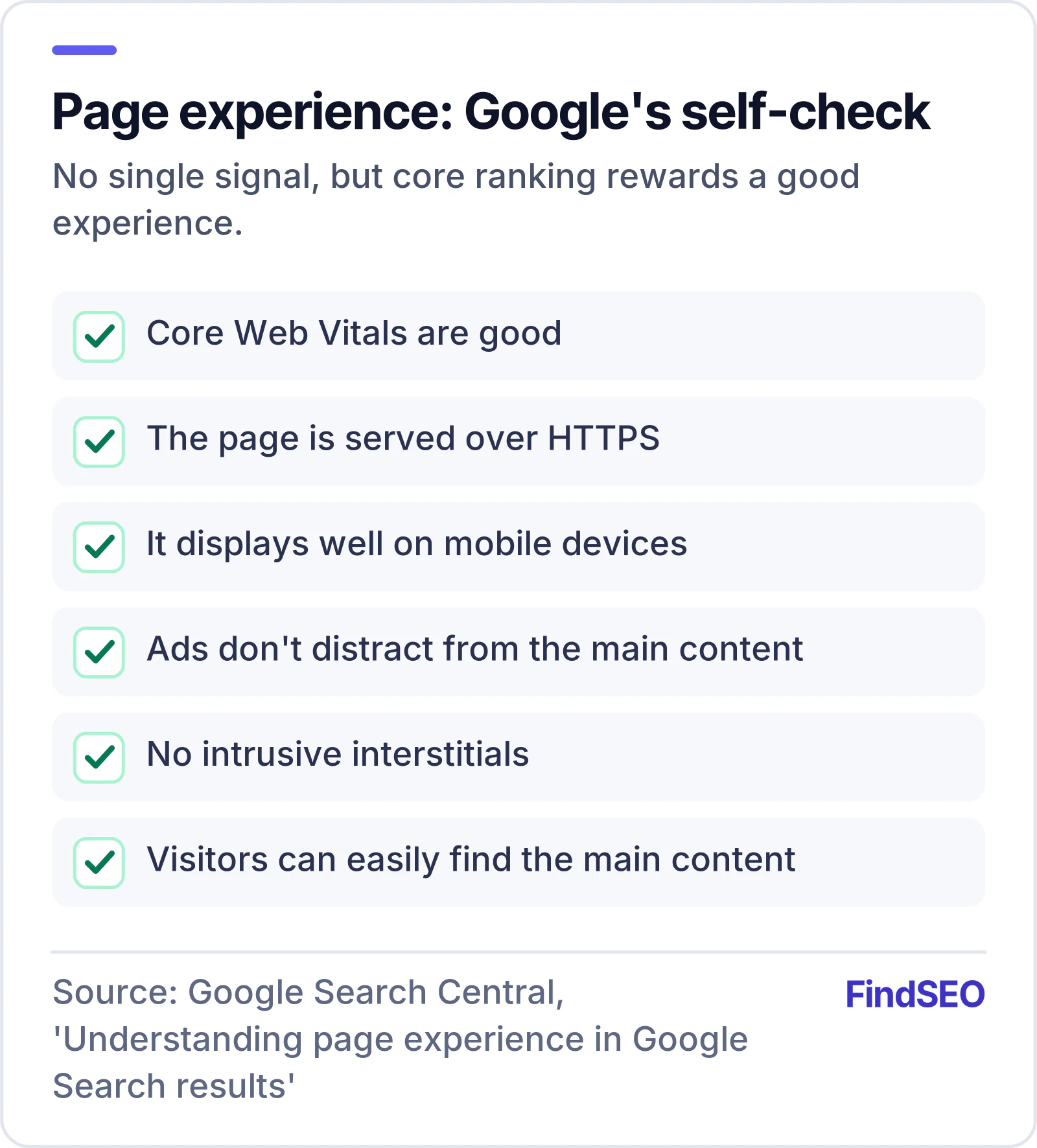
Page experience isn't a single system in the guide. Google's page experience documentation says there's no single page experience signal, but its core ranking systems look to reward content with a good page experience, and Core Web Vitals are used by those systems. Our article on whether Core Web Vitals affect rankings explains how much weight to give them.

Checklist of Google's page experience self-assessment points: good Core Web Vitals, served over HTTPS, displays well on mobile, ads don't distract from the main content, no intrusive interstitials, and the main content is easy to find.
Google's own page experience questions. Passing them supports ranking but won't outweigh relevance.

Which systems shape the results page?

Some systems don't decide whether a page is good. They decide how the final list looks:

  1. Deduplication shows only the most relevant of very similar pages. If a page is chosen as a featured snippet, Google doesn't repeat it later on the first page.
  2. Site diversity means Google generally won't show more than two listings from the same site in the top results, unless more are especially relevant. Subdomains are generally treated as part of the root domain, which matters if you're weighing a ccTLD, subdomain or subfolder.
  3. Freshness systems ("query deserves freshness") show newer content where people expect it. Google's examples are a just-released film and a search for "earthquake" just after one has happened.
  4. Local news systems surface local news sources in features such as Top stories.
  5. Crisis information systems show hotlines and trusted organisations for personal crisis searches, and official updates through SOS Alerts during disasters.
Green cardboard punnets of red and orange cherry tomatoes on a market stall, with a handwritten sign reading organic fresh cherry tomatoes.
Freshness matters for some searches, like news and new releases, not for every page. Photo: Anne Preble, CC0, via Wikimedia Commons.

Freshness is the one most often misread. It applies to searches where recent information is expected. It doesn't mean every page needs a new date. Our guide on how often to update content covers when a refresh actually helps. Duplication works the same way: it's a filtering step, not a penalty, as our article on whether duplicate content hurts SEO explains.

Which systems demote sites?

The last group pushes content down:

System What triggers it What you can do
Spam detection, including SpamBrain Content and behaviour that breaks Google's spam policies Follow the policies, and reject tactics that break them
Removal-based demotion A significant volume of valid removal requests, such as copyright, defamation or exploitative personal-information removals Publish only content you have the right to use
Exact match domain system Domains built to match a search exactly, such as Google's "best-places-to-eat-lunch" example Don't rely on a keyword domain to rank

Spam detection is separate from a manual action, which is a penalty applied after a human at Google reviews a site and is shown in Search Console. Our guide to Google's spam policies covers which tactics count as spam. Be wary of any agency offering shortcuts that sound like black-hat SEO.

Which systems has Google retired?

Some famous names are no longer separate systems. Google lists them "for historical purposes": each was either merged into a successor system or made part of the core ranking systems.

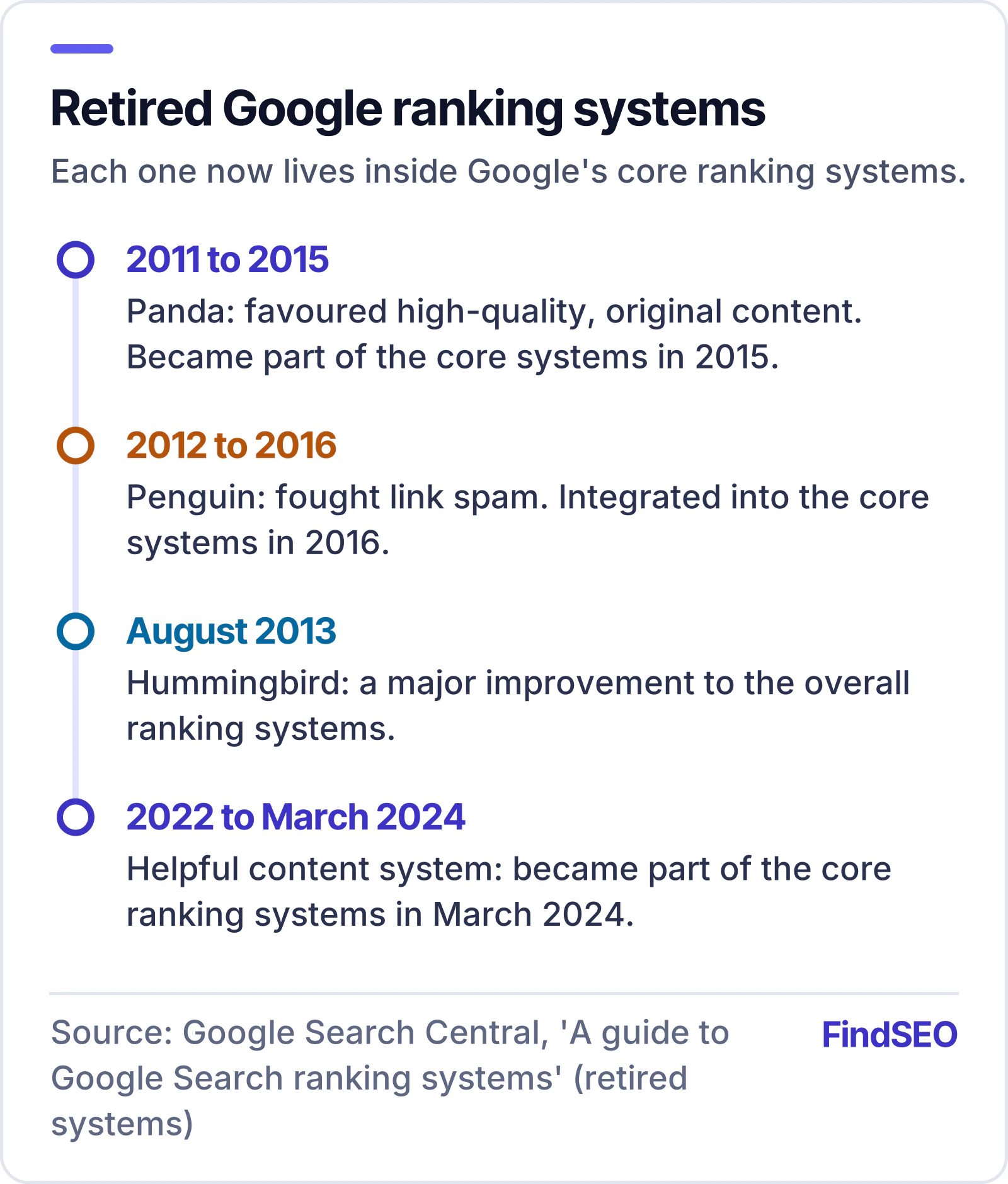
  1. Panda, announced in 2011 to favour high-quality, original content, became part of the core systems in 2015.
  2. Penguin, announced in 2012 to fight link spam, was integrated into the core systems in 2016.
  3. Hummingbird was a major improvement to the overall ranking systems in August 2013.
  4. The helpful content system, announced in 2022 as the "Helpful Content Update", became part of the core ranking systems in March 2024.
Timeline of retired Google ranking systems: Panda, announced 2011, became part of core ranking in 2015; Penguin, announced 2012, was integrated in 2016; Hummingbird was a major ranking improvement in August 2013; and the helpful content system, announced 2022, joined core ranking in March 2024.
Panda, Penguin and helpful content are no longer separate systems you can be hit by.

So when someone says a site was "hit by Panda" or "hit by the helpful content update" today, they really mean the core ranking systems. That has a practical consequence: there's no separate system to recover from. Changes now show up through core ranking generally and through the core updates Google makes several times a year. Our article on Google core updates explains how to read a drop after one, and the helpful content entry covers what that system was looking for.

What can a business actually influence?

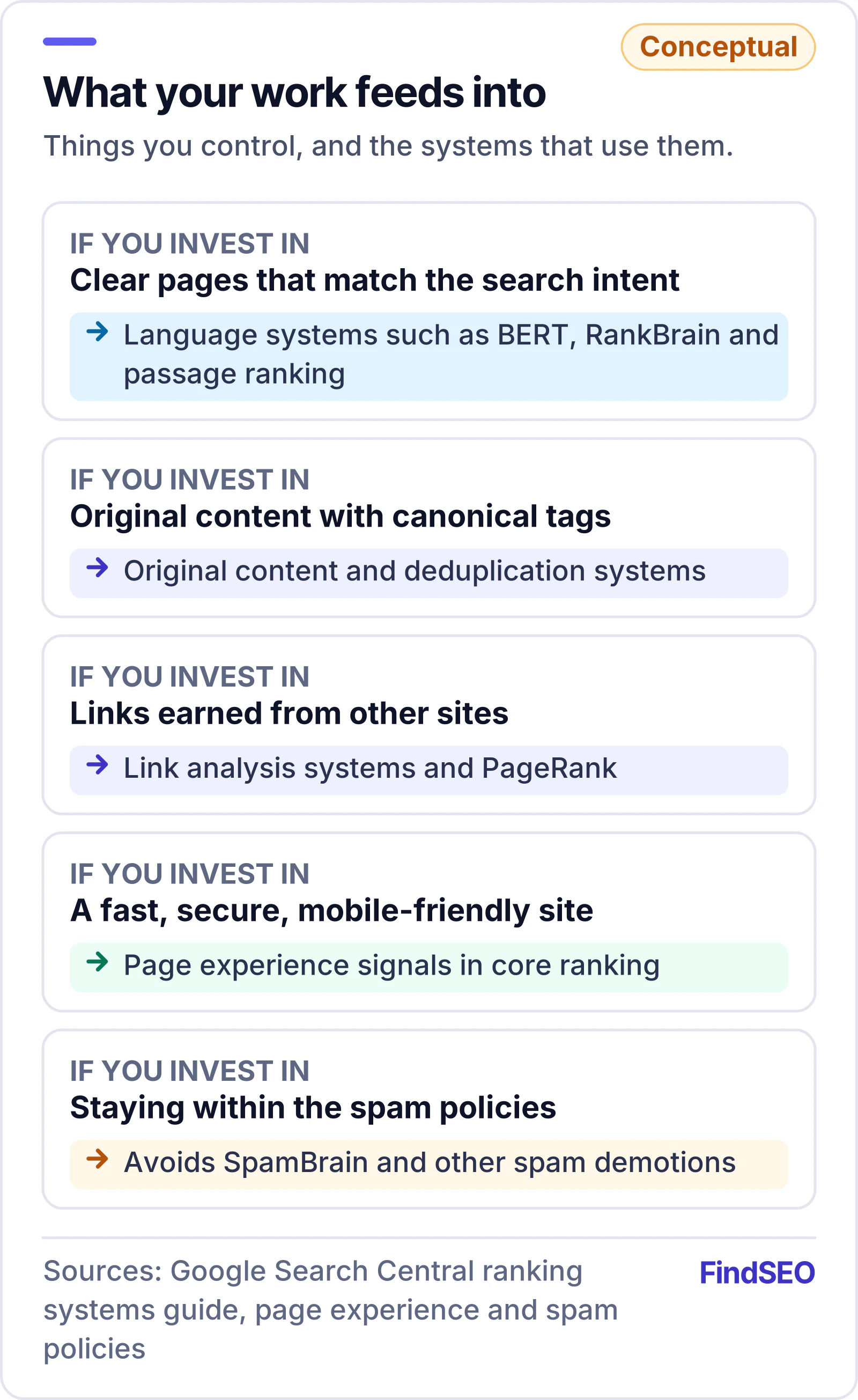
You can't switch any of these systems on or off, but you can supply what they look for. In practice, these are the levers that matter:

  1. Write for the search, not the keyword. Cover the question fully and structure the page so each section can stand alone. Google's guidance on helpful, people-first content has self-assessment questions you can work through.
  2. Be original. Add first-hand experience, your own data or real examples, and use canonical tags where content is syndicated.
  3. Earn links honestly. Links still feed PageRank, so build a site worth linking to. Our page authority checker gives a rough read on how a page compares.
  4. Keep the technical basics sound. A clean, fast, mobile-friendly site supports page experience. A technical SEO service or a one-off SEO audit will find what's blocking you.
  5. Stay clear of spam. No scaled thin content, link schemes or keyword-stuffed domains.
  6. Track the right outcomes. Watch Search Console and leads, not daily ranking swings. Our SEO ROI calculator helps you judge whether the work is paying off.
Guide matching site work to Google's systems: clear intent-matched pages feed language systems such as BERT, RankBrain and passage ranking; original content with canonical tags feeds original content and deduplication systems; earned links feed link analysis and PageRank; a fast, secure, mobile-friendly site feeds page experience signals; and following the spam policies avoids SpamBrain demotions.
You can't control the systems, but you can control what they find.

A ranking systems checklist for site owners

Use this checklist when you review your own site or an agency's plan:

  • Each important page answers one clear search intent.
  • Headings make individual passages easy to find.
  • Content is original or adds something to what already ranks.
  • Duplicated or syndicated pages carry a canonical tag.
  • Review content shows real testing or expertise.
  • Links are earned, not bought or exchanged.
  • Pages pass Core Web Vitals and work well on mobile.
  • Nothing on the site breaks Google's spam policies.
  • You check the ranking update history on Google's Search Status Dashboard before blaming an update for a drop.

If an agency's pitch leans on "beating the algorithm", ask which of these systems the work affects and how. A good answer will sound like this checklist. You can compare providers in our agency directory for Australia, including SEO agencies in Melbourne, or let us suggest a shortlist through Get Matched.

The bottom line

Google's ranking systems are many specialised parts, not one secret formula, and Google documents the notable ones publicly. Language systems work out what a search means. Quality systems reward reliable, original, well-linked pages. Results-page systems keep the list varied and fresh. Spam systems push down manipulation. Retired names such as Panda, Penguin and helpful content now live inside core ranking. Build pages that are clearly useful and honest, keep the site technically sound, and the systems are working with you rather than against you.

FAQs

How many ranking systems does Google use?

Google doesn't publish a total. Its ranking systems guide covers only its more notable systems, and its core ranking systems combine many signals and smaller systems that aren't listed individually.

Is RankBrain still used?

Yes. Google lists RankBrain among its current ranking systems. It helps Google understand how words relate to concepts, so it can return relevant pages that don't contain every word in a search.

Are Panda and Penguin still running?

Not as separate systems. Google says Panda became part of its core ranking systems in 2015 and Penguin was integrated into them in 2016. The same happened to the helpful content system in March 2024.

Does Google show more than two results from the same site?

Usually not in the top results. Google's site diversity system generally limits a site to two listings, but it may show more when they're especially relevant to the search. Subdomains are generally counted as part of the root domain.

Does the reviews system judge customer reviews on my site?

No. Google says the reviews system evaluates first-party review articles and blog posts, not third-party reviews left by users, such as product or service reviews from customers.

Sources

Ready for help with SEO?

Compare SEO-only agencies near you, with client reviews checked by a person, or tell us what you need and get matched.