Check an SEO agency's reviews, case studies and credentials before you sign by asking for evidence you can test, not just evidence you can read. Look for patterns that suggest fake reviews, ask for named case studies with dates, ask to see real client data on a call, speak to a past client yourself, and confirm what each badge actually measures. Google's own advice is to ask for examples of past work and to check business references.
Most agencies look impressive on their own website. That's the point of a website. The work is in finding out which claims hold up, and it doesn't take long if you know what to ask for. This guide sits alongside our questions to ask an SEO agency: those questions tell you how an agency works, and the checks below tell you whether its proof is real.
Why should you check an agency's proof at all?
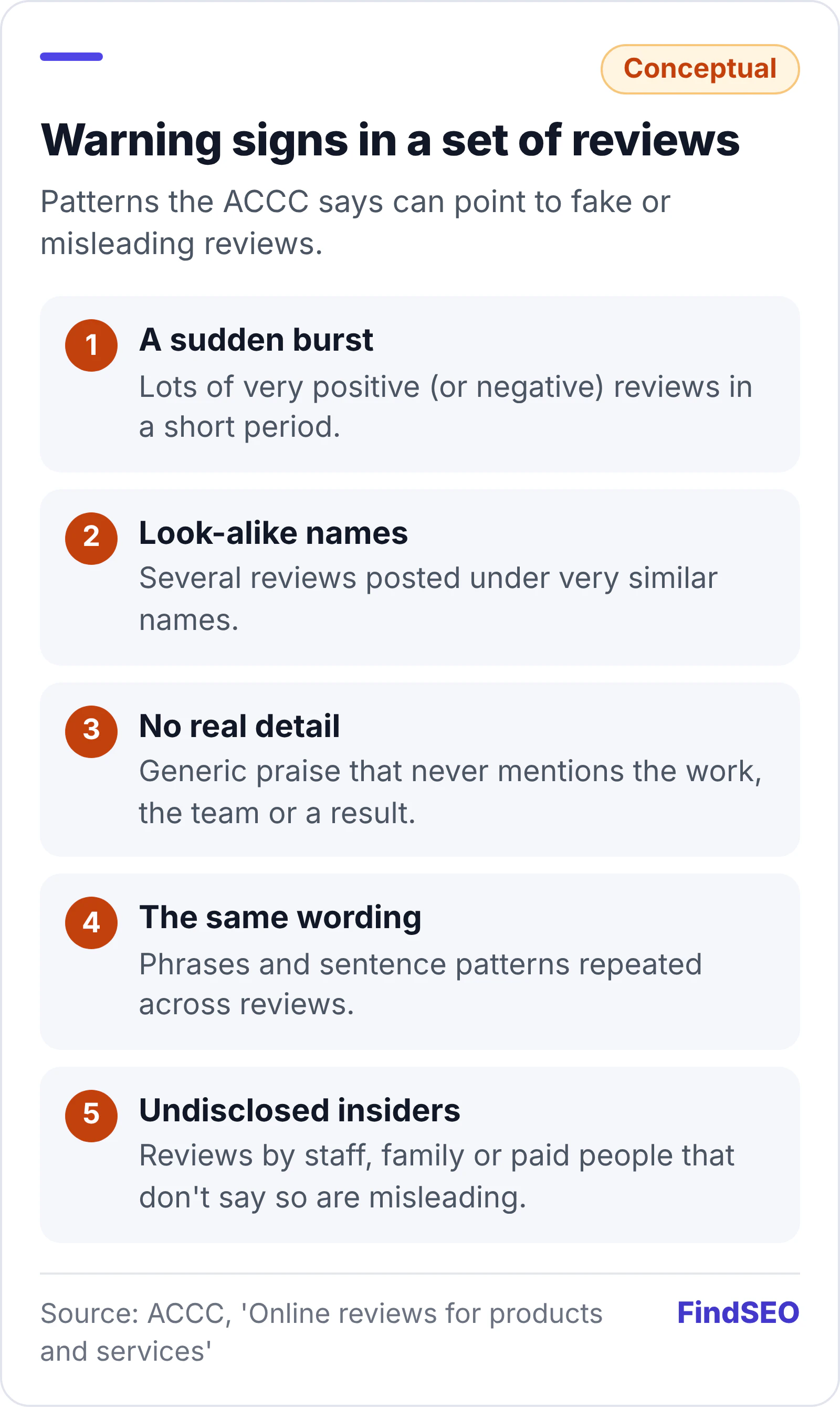
Because you carry the risk. Google's page Do you need an SEO? says plainly that you're responsible for the actions of the companies you hire, and it suggests asking any SEO to show examples of previous work and share success stories. It also recommends checking business references: ask past clients whether the service was useful, whether the agency was easy to work with and whether the work produced positive results.
The stakes are real. An agency that cuts corners can land your site in trouble with Google's spam policies, and black hat SEO tactics rarely show up in a glossy case study. Checking proof before you sign is far cheaper than switching SEO agencies a year later.
How do you tell if an SEO agency's reviews are genuine?
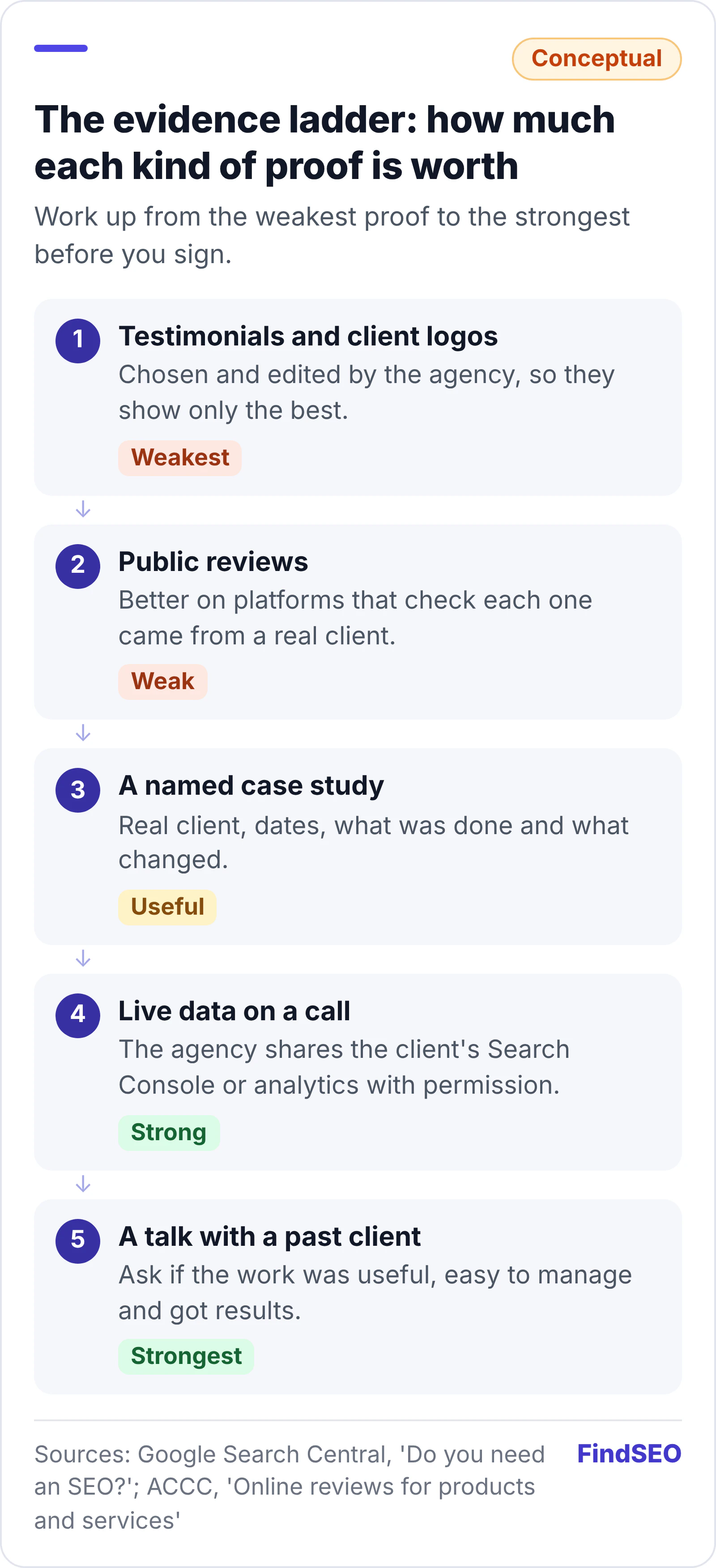
Start with the pattern, not the star rating. The ACCC's guidance on online reviews says it's illegal for a business to create or arrange fake or misleading reviews, and it lists signs that reviews may not be genuine. Read an agency's reviews across every platform you can find and look for:
- A sudden burst. A spike of very positive (or very negative) reviews over a short period.
- Look-alike names. Several reviews posted under very similar names.
- No real detail. Generic praise that never mentions the work, the team or a result.
- The same wording. Similar language and phrasing repeated across different reviews.
- Undisclosed insiders. The ACCC says reviews can mislead when they're written by staff, family or paid people without saying so, by someone who never used the service, or when they've been edited after the fact.
Where a review lives matters too. Google's Maps user-generated content policy says reviews must reflect a genuine experience, bans paid reviews and conflicts of interest, and says businesses mustn't offer incentives for reviews or ask only happy customers for them. The ACCC adds that platforms which check a review came from a real customer may be more reliable. On FindSEO, every review is confirmed by email and checked by a person before it's published, and agencies can't pay to remove one; you can read how we verify reviews.
The same rules apply in the US. In August 2024 the Federal Trade Commission announced a final rule banning fake reviews and testimonials, including bought positive or negative reviews, undisclosed insider reviews and company-run "independent" review sites. If you'd like the other side of the picture, our guide to getting more Google reviews shows what honest review collection looks like.

What should a real SEO case study include?
A case study is a claim about someone else's business, so it should give you enough detail to test it. A useful one includes:
- A named client and website, or a clear reason it can't be named, such as a signed confidentiality agreement.
- Dates. When the work started, when results were measured and how long they've lasted.
- The starting point. What was wrong or missing before the agency began.
- What the agency actually did, in plain words, not just "a full SEO strategy".
- Results tied to the business, such as enquiries, sales or revenue, not only rankings or traffic. Our guide to measuring SEO ROI explains which numbers matter.
- Context. Seasonality, site launches or ad spend that might explain part of the change.
Then check it. Visit the client's site and see whether it still exists and still looks like the work described. A case study that only shows a cropped chart with no dates or axis labels proves very little.
How can you verify results without seeing a client's private data?
Ask the agency to show you the numbers live. A confident agency can open Google Search Console or Google Analytics 4 for a willing client on a video call, with the client's permission, and walk you through the date range. Watch for comparisons that start at an unusually low month, and ask what else changed in the same period.
It also helps to know what normal access looks like. Google's guide to Search Console permissions explains that owners have full control, full users can view all data and take some actions, and restricted users can view most data. Only owners can add users. Google's hiring advice suggests that an SEO doing an audit should only need read access.
| Search Console role | What it allows | When to give it to an agency |
|---|---|---|
| Restricted user | View most data | A pre-sale look or an audit |
| Full user | View all data and take some actions | Once a contract is signed |
| Owner | Full control, including adding and removing users | Rarely: keep ownership in your business |
If an agency asks for owner access to your site before you've signed anything, ask why.
Monthly reports are evidence too. Ask for a sample report from a current client with the name removed, and compare it with our guide to what an SEO report should include.
What do agency badges and certifications really prove?
Less than they suggest, unless you know what was measured. The Google Partner badge is a good example. Google's page on how to become a Google Partner sets three requirements, all about Google Ads, not organic search.
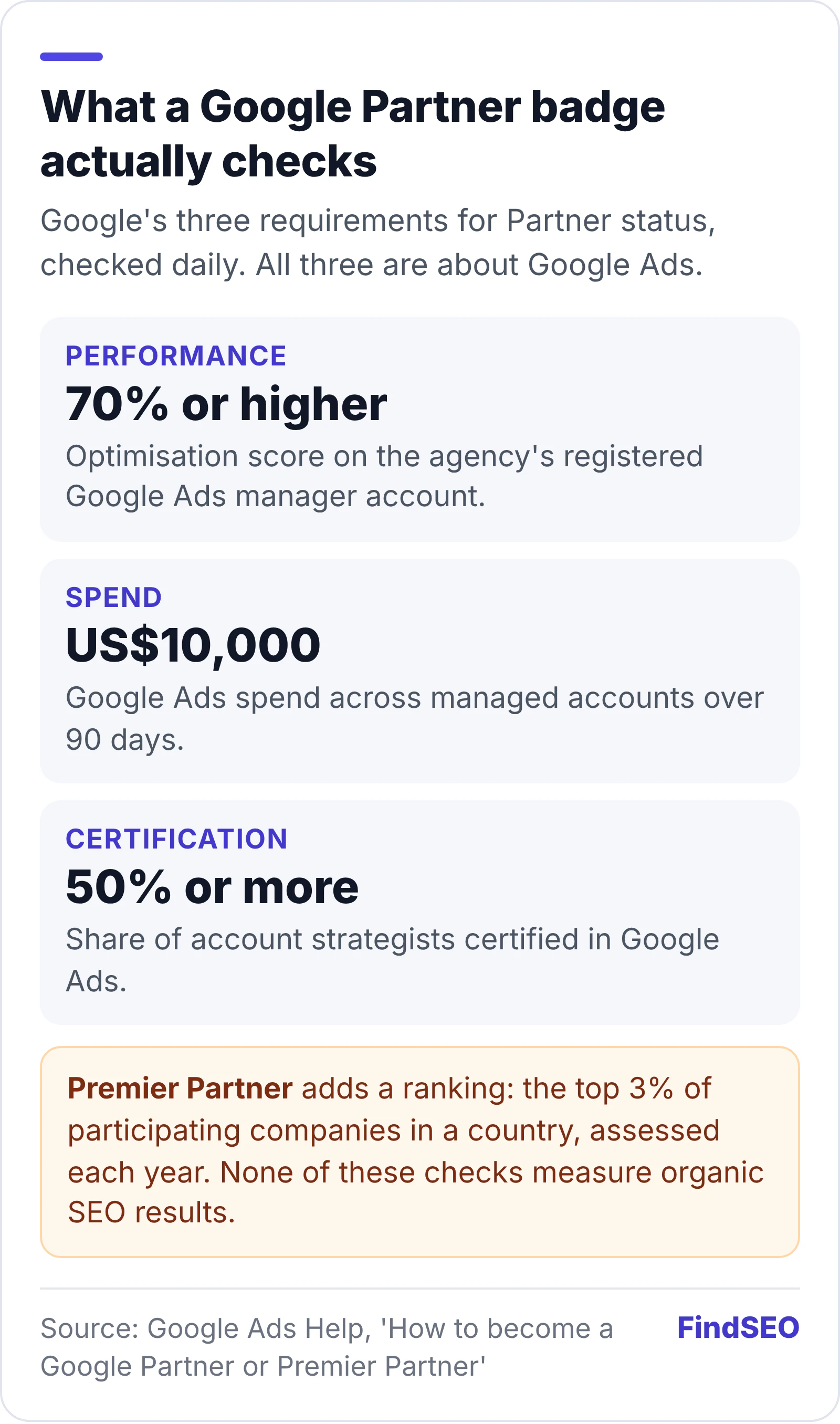
Google also says it doesn't evaluate or endorse third-party SEO tools, and its hiring advice warns against anyone who claims a "special relationship" with Google. Treat any badge the same way: find out who awarded it, what it measured and whether it still applies. FindSEO publishes the criteria behind every one of its agency badges and awards.
How do you check the business behind the agency?
In Australia, look the agency up on ABN Lookup. It's free and shows whether an ABN is active or cancelled, the business type, GST status and historical trading names. Check that the name on the proposal matches the business you're paying, and ask about it if the registered details don't match how the agency describes itself.
Claims on an agency's site are covered by the law as well. The ACCC's guidance on false or misleading claims applies to testimonials and websites, so a made-up result isn't just bad marketing. And if a pitch promises guaranteed rankings, read our guide to fake SEO guarantees before you go any further.

Agency proof checklist
- Reviews read on at least two platforms, including the negative ones
- No sudden bursts, look-alike names or repeated wording in the reviews
- At least two case studies with a named client, dates and business results
- Client sites in the case studies checked and still live
- Results shown live in Search Console or analytics, with permission
- One conversation with a past client, ideally one you found yourself
- Every badge checked: who awarded it, what it measured and whether it's current
- ABN active and matching the business named on the proposal
- Access requested is read-only until a contract is signed
- No ranking guarantees or claims of a special relationship with Google
What should you ask the agency directly?
- Can we speak to a client you worked with in the last year? Ask the client the three questions Google suggests: was the work useful, was the agency easy to work with and did it get results?
- Can you show me the data behind this case study? A live screen share beats a screenshot.
- What went wrong on a past project, and what did you do? Honest agencies have an answer.
- Who exactly will work on our account? The people in the case study should be the people doing your work.
- What does this badge measure? If they don't know, it's decoration.
Once the proof checks out, compare the shortlist side by side with our guide to comparing SEO agency proposals, work through the Academy lesson on evaluating proposals and spotting red flags, and make sure the promises end up in writing with our guide to what an SEO contract should include.
Bottom line
Good agencies welcome scrutiny, because their proof survives it. Look for patterns in reviews rather than star ratings, insist on named and dated case studies, ask to see real data live, talk to a past client and find out what every badge actually measures. To see what the right agency could be worth to you, try the SEO ROI calculator, and check how a case study site stacks up with the Page Authority Checker. When you're ready to shortlist, browse SEO agencies in Australia, start with SEO agencies in Melbourne, or use Get matched to be introduced to agencies that fit your brief.