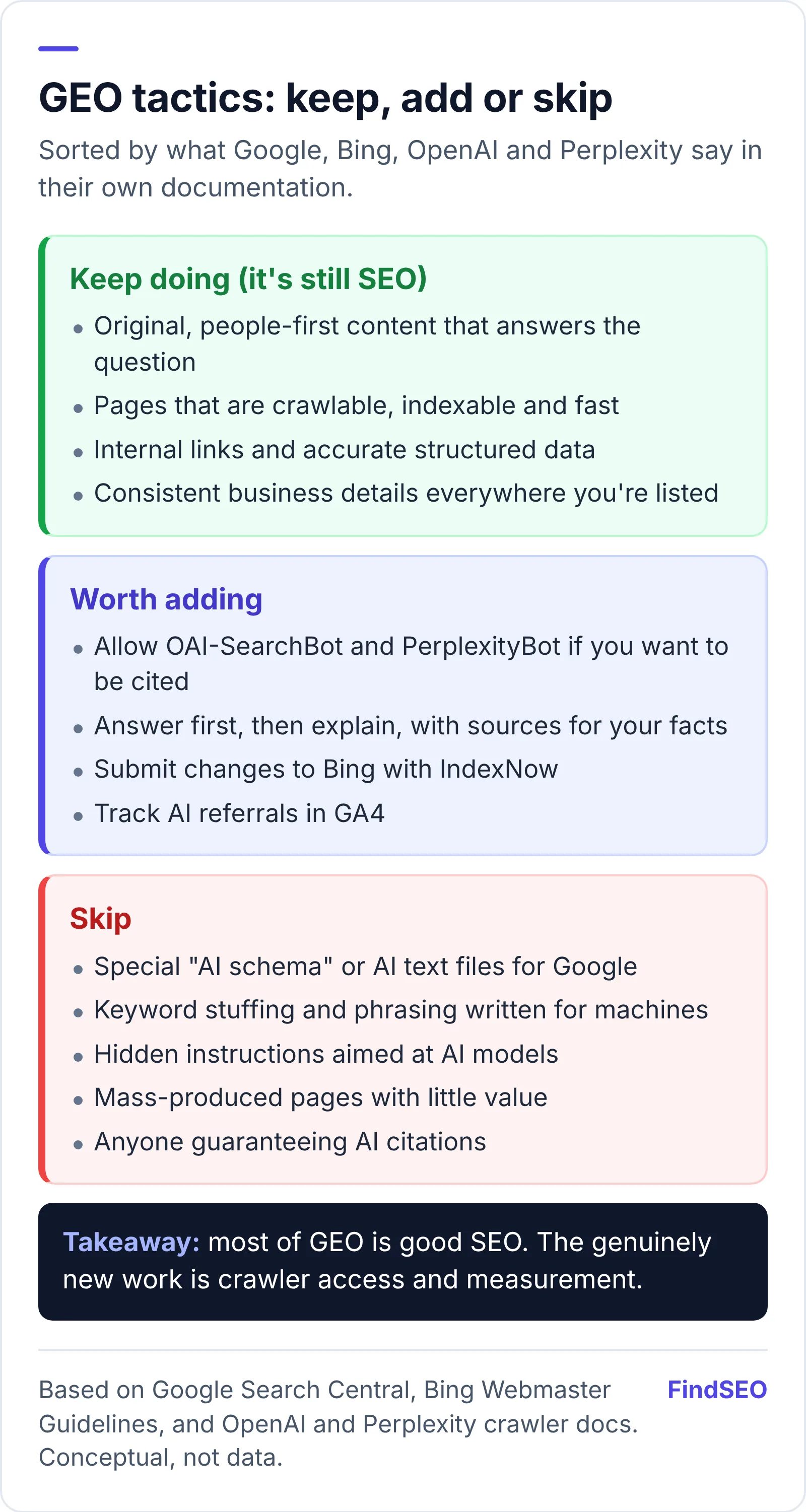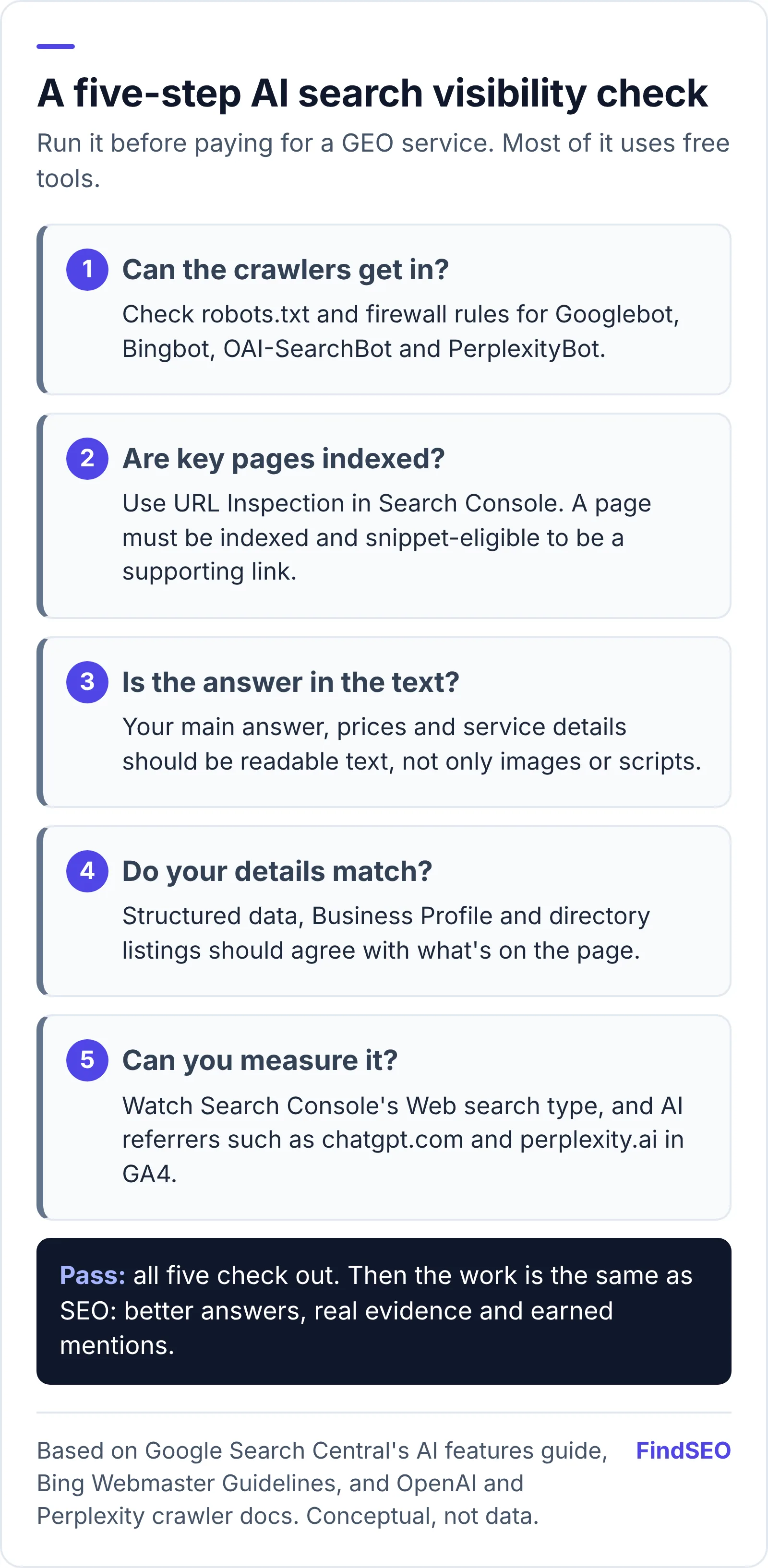
Generative engine optimisation (GEO) is mostly SEO under a new name. Google says there are no additional requirements or special optimisations for AI Overviews and AI Mode, and Bing says SEO fundamentals still apply to Copilot and its AI answers. What genuinely changes is the work around the edges: letting each AI search crawler in, writing pages that are easy to quote, and measuring visibility that doesn't show up as a ranking. If someone sells GEO as a separate discipline with its own secret rules, ask them to show you where the search engines say so.
This guide covers where the term came from, what the platforms say, what's different, what to skip and what to ask before paying for GEO.
What is generative engine optimisation (GEO)?
GEO is the practice of making your content more likely to be used and cited in the answers that AI search tools give, such as Google's AI Overviews and AI Mode, Microsoft Copilot, ChatGPT search and Perplexity. Our glossary entry on generative engine optimisation gives the short definition.
The term comes from a research paper, GEO: Generative Engine Optimization, first posted in November 2023 and presented at the ACM KDD conference in 2024. It described "generative engines" as search tools that gather sources and summarise them with a language model.
You'll also see answer engine optimisation (AEO), LLM optimisation and "AI SEO". They describe the same goal: being the source an AI answer draws on, and earning an AI citation with a link back to your site.
What do Google and Bing say about optimising for AI answers?
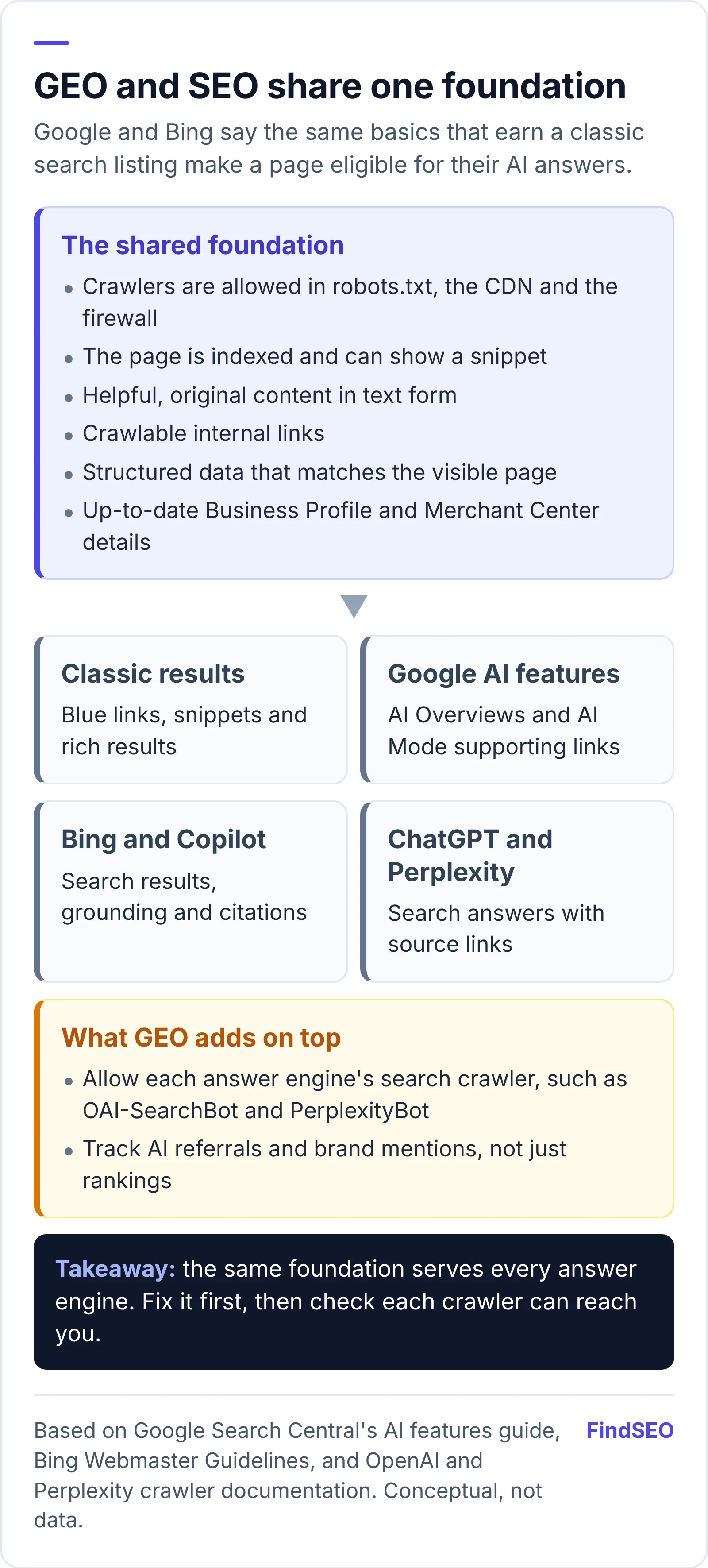
Both say the same thing: do SEO well. Google's guide to AI features and your website states that "the best practices for SEO remain relevant" and that "there are no additional requirements to appear in AI Overviews or AI Mode, nor other special optimizations necessary."
The technical bar is the same too. To be shown as a supporting link, Google says a page "must be indexed and eligible to be shown in Google Search with a snippet." It lists the SEO fundamentals that still matter:
- Allowing crawling in robots.txt, and by any CDN or hosting infrastructure.
- Making content easy to find through internal links.
- Providing a good page experience.
- Making important content available as text.
- Supporting text with high-quality images and video where they help.
- Making sure structured data matches the visible text on the page.
- Keeping Merchant Center and Business Profile information up to date.
Google also says you don't need new machine-readable files, AI text files or special schema.org markup to appear in these features. That's why we don't recommend an llms.txt file as a way to win in Google.
Bing is just as direct. Its Webmaster Guidelines open with a section titled "SEO Fundamentals Still Apply to Grounding and AI Experiences", explaining that Bing and Copilot "rely on the same core crawling, indexing, and ranking foundation as traditional search."