AI search

Does AI Content Hurt SEO? What Google Actually Says

Google doesn't penalise content for being made with AI. It penalises content made mainly to manipulate rankings. What's allowed, what's spam and how to publish safely.

FindSEO7 min read

Close-up of the round black keys on a 1940s manual typewriter, rows of white letters and numbers lit by soft daylight.

Photo: Cbaile19 / Wikimedia Commons (CC0)

In this article
  1. What has Google said about AI content?
  2. When does AI content become spam?
  3. Is lightly edited AI content "low effort"?
  4. Why does fact-checking matter so much?
  5. Should you disclose that you used AI?
  6. How do you use AI for content safely?
  7. An AI content checklist
  8. The bottom line

No, not on its own. Google says it rewards high-quality content "however it is produced", and that appropriate use of AI or automation isn't against its guidelines. What hurts is using AI, or any tool, to churn out many pages that add little value, mainly to manipulate rankings. Google calls that scaled content abuse, and it's a breach of its spam policies. The test is the same one Google applies to human writing: is the page original, accurate and genuinely useful to the people reading it?

This guide sets out what Google has said about AI content, where the line sits between helpful and spammy use, and a practical workflow for publishing pages made with AI help without putting your rankings at risk.

What has Google said about AI content?

Google set out its position in a February 2023 Search Central Blog post on AI content. Its ranking systems aim to reward original, high-quality content that shows E-E-A-T: experience, expertise, authoritativeness and trustworthiness. Google said its focus is on the quality of content, rather than how it's produced.

The same post answers the questions most business owners ask:

  1. Is AI content against the guidelines? No. Appropriate use of AI or automation isn't. Using it to generate content primarily to manipulate search rankings is.
  2. Will AI content rank highly? Google says using AI doesn't give content any special gains. "It's just content." If it's useful, helpful and original, it might do well. If it isn't, it might not.
  3. Should you use AI to write content? Google's answer: if you see AI as a way to help you produce helpful, original content, it might be worth considering. If you see it as a cheap, easy way to game rankings, then no.

Google also pointed out that automation has long produced useful content, such as sports scores, weather forecasts and transcripts. Its current guidance on using generative AI content adds that AI can be particularly useful when researching a topic and adding structure to original content.

When does AI content become spam?

When it's used to produce lots of pages that don't help anyone. Google's scaled content abuse policy covers "many pages" generated mainly to manipulate rankings rather than help users, "no matter how it's created". Its examples include:

  1. Using generative AI tools or similar tools to generate many pages without adding value for users.
  2. Scraping feeds, search results or other content and turning it into pages, including through synonymising, translating or other automated rewording.
  3. Stitching or combining content from different web pages without adding value.
  4. Creating multiple sites to hide the scaled nature of the content.
  5. Publishing pages that make little sense to a reader but are full of search keywords.
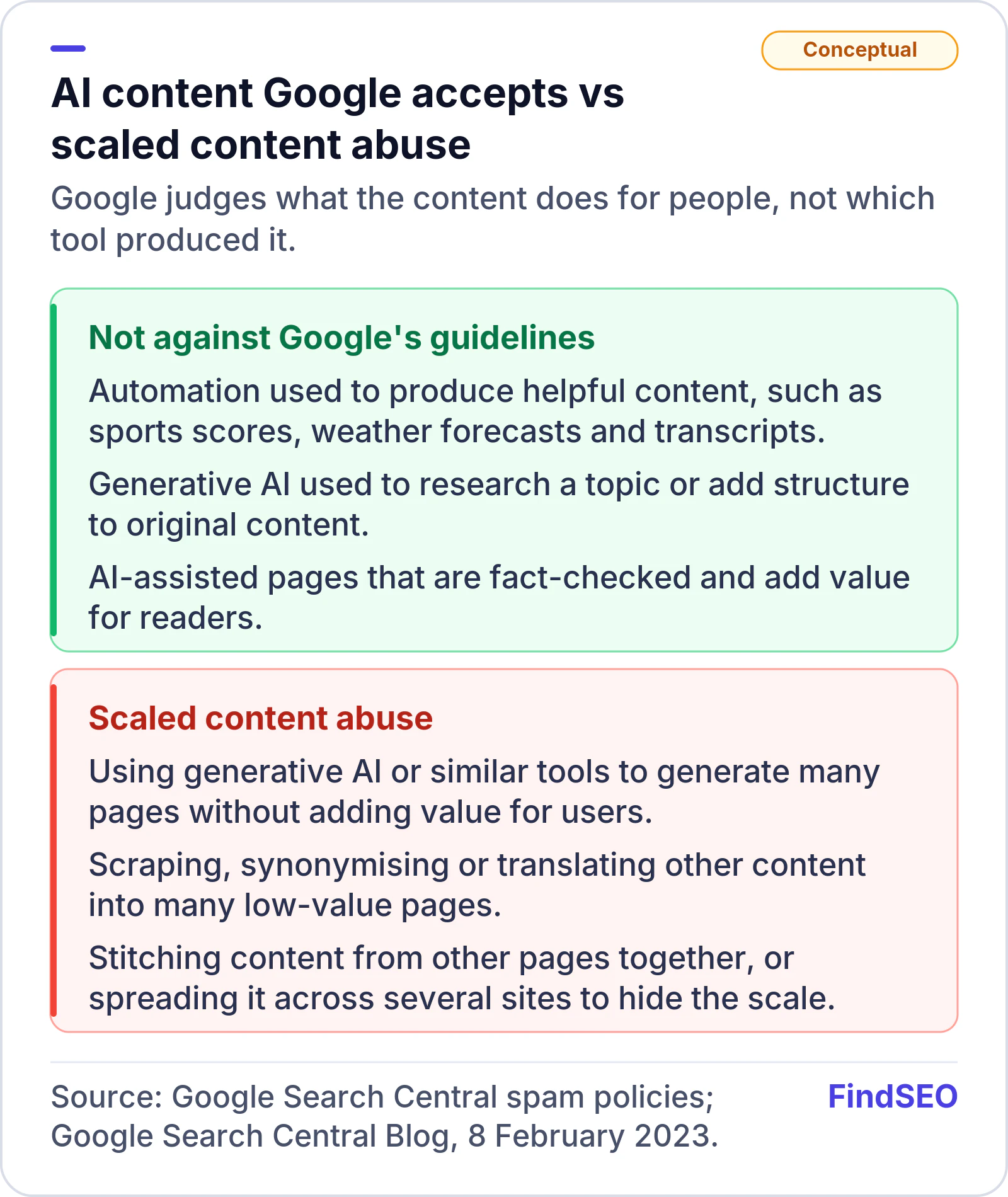
Comparison of AI content Google accepts and scaled content abuse. Not against Google's guidelines: automation for helpful content such as sports scores, weather forecasts and transcripts; generative AI used to research a topic or add structure to original content; and pages made with AI help that are fact-checked and add value. Scaled content abuse: generating many pages without adding value, scraping, synonymising or translating content into low-value pages, and stitching content together or spreading it across sites to hide the scale. Source: Google Search Central spam policies and Google Search Central Blog, 8 February 2023.
The tool doesn't decide which side a page falls on. The value it adds does.

Google detects spam through automated systems, including the SpamBrain system named in its 2023 post, and through human review that can lead to a manual action. Its spam policies say sites that breach them may rank lower or not appear in results at all. The policy was introduced with Google's March 2024 core update and new spam policies, and our overview of Google's spam policies explains how it fits with the others.

The pattern matters more than the tool. A business that pumps out hundreds of near-identical suburb pages is at risk whether a writer or a model produced them. Our guide to location pages without doorway spam shows what a safe version looks like, and does duplicate content hurt SEO? covers the overlap with copied text.

Is lightly edited AI content "low effort"?

It can be. Google's guide to creating helpful, reliable, people-first content says its quality raters assess the effort, originality, talent or skill, and accuracy of a page's main content. It gives "using generative AI to produce large amounts of text without manual oversight or curation" as an example of little to no effort, and notes that crediting other sources doesn't replace the need for original effort.

The generative AI guidance also points to two sections of the Search Quality Rater Guidelines: scaled content abuse (section 4.6.5) and main content made with little to no effort, originality or added value (section 4.6.6). Google is clear that raters don't directly influence rankings. Their ratings help it check its systems are working. Our explainer on the quality rater guidelines covers how that works.

In practice, "low effort" looks like pages that only summarise what's already ranking. Google's helpful content page lists warning signs, including "using extensive automation to produce content on many topics" and "mainly summarizing what others have to say without adding much value". Our plain-English take on Google's helpful content self-assessment walks through the rest.

Why does fact-checking matter so much?

Because AI tools can be confidently wrong. Google's generative AI guidance explains that generative models "don't retrieve facts, but predict a likely sequence of words", so outputs may contain inaccuracies, often called hallucinations. It says it's critical to manually fact-check and review all content made with AI for accuracy before publishing.

Extreme close-up of a sharpened pencil tip, the graphite point glinting blue-grey against splintered pale wood.
A human edit is where an AI draft earns its place on your site. Photo: Drummyfish, CC0, via Wikimedia Commons.

That review isn't just for the visible text. Google says it also applies to metadata that can show in search results: title elements, meta descriptions, structured data and alt text for images. If you generate schema markup, Google adds that it must follow its general structured data guidelines and the policies for each search feature, and be validated. Our guide to why Google rewrites title tags shows what happens when titles don't match the page.

Accuracy matters most on what Google calls "Your Money or Your Life" topics. Google says its systems give even more weight to strong E-E-A-T on topics that could significantly affect people's health, financial stability or safety, and its 2023 post says the same applies to health, civic and financial information.

Should you disclose that you used AI?

Where readers would reasonably expect it. Google suggests asking "Who, How and Why" about any page:

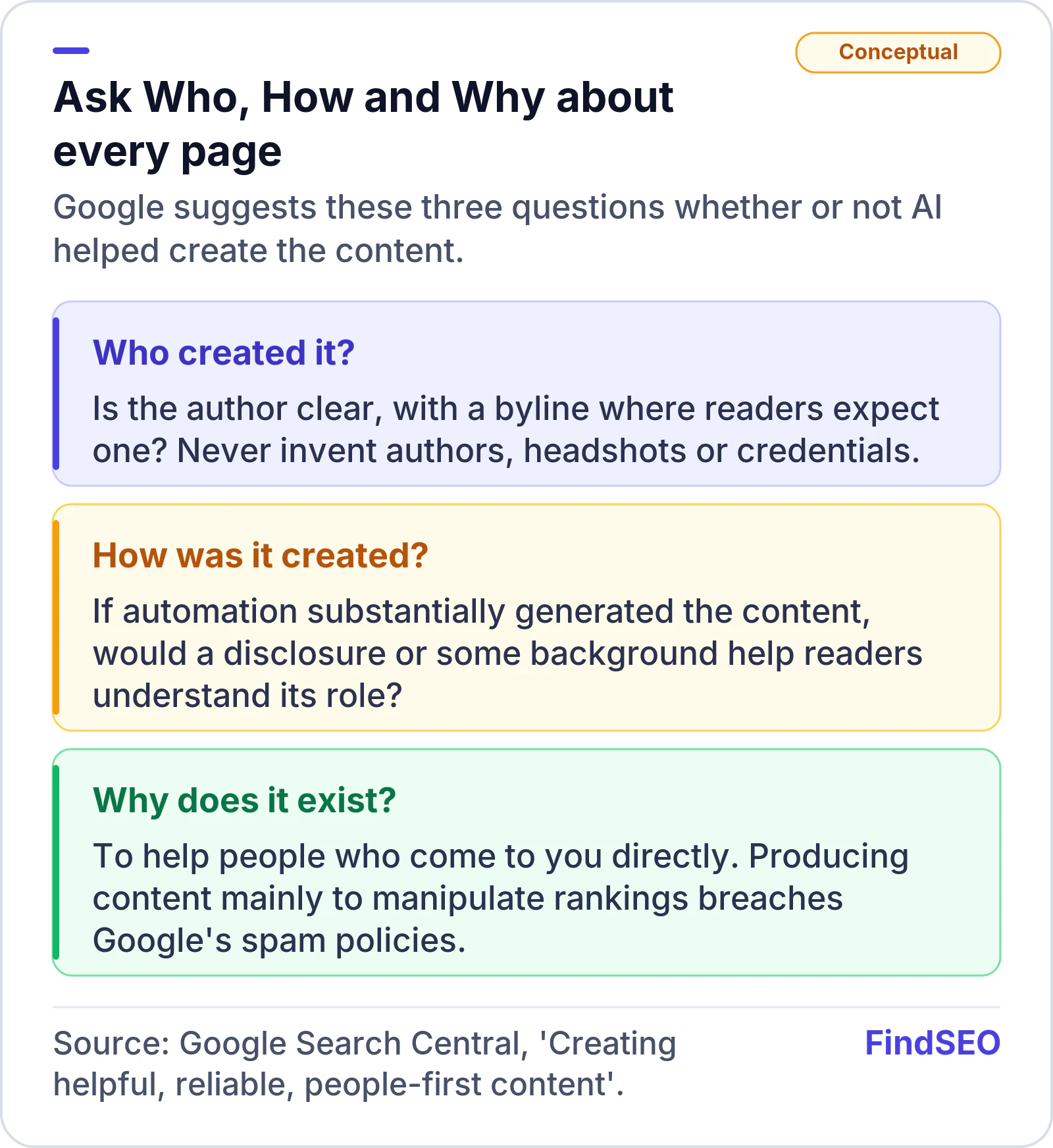
Google's Who, How and Why questions for any page. Who created it: is the author clear, with a byline where readers expect one, and never invented authors, headshots or credentials. How was it created: if automation substantially generated the content, would a disclosure or background help readers understand its role. Why does it exist: to help people who come to you directly, because producing content mainly to manipulate rankings breaches Google's spam policies. Source: Google Search Central, Creating helpful, reliable, people-first content.
Of the three, Google calls Why perhaps the most important question.
  1. Who created the content. Google encourages accurate bylines where readers expect them. It also warns that fabricating creator profiles, such as fake AI headshots, made-up names or false credentials, is deception that makes a page untrustworthy. Giving AI the byline itself is, in Google's words, "probably not the best way" to make its role clear.
  2. How it was created. If automation substantially generated the content, Google suggests disclosures or background on how and why it was used, where someone might wonder "How was this created?".
  3. Why it was created. The answer should be to help people. Content made mainly to attract search visits isn't what Google's systems reward.

Online stores have firmer rules. Google's generative AI guidance says Merchant Center requires images made with AI tools to carry the IPTC DigitalSourceType value TrainedAlgorithmicMedia in their metadata, and AI product titles and descriptions to be labelled separately. See Google's Merchant Center policy on AI content for the details.

How do you use AI for content safely?

Treat AI as a drafting and research assistant, not a publisher. This workflow follows Google's guidance step by step:

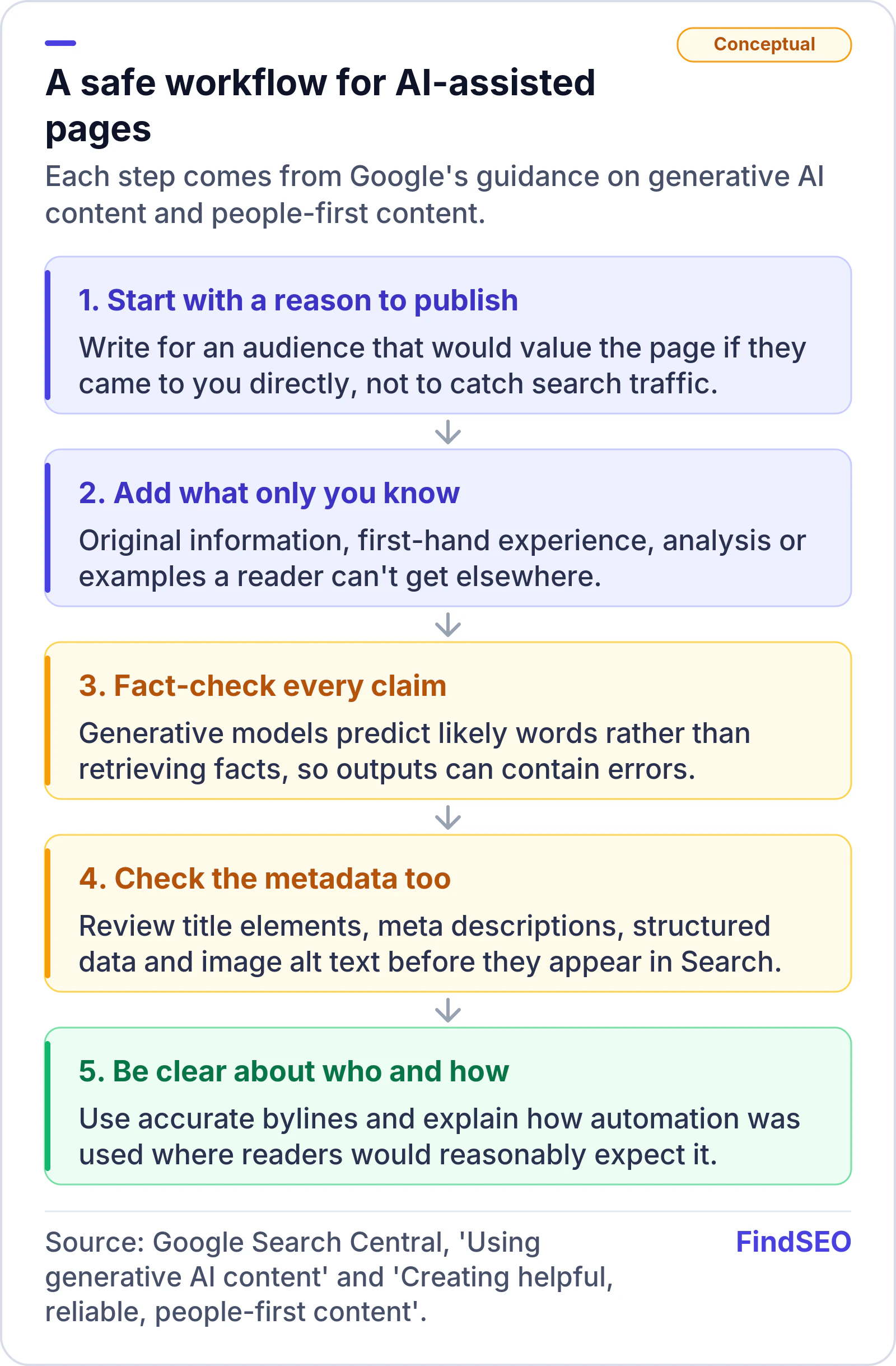
A five-step workflow for pages made with AI help based on Google's guidance: one, start with a reason to publish for an audience that would value the page directly; two, add original information, first-hand experience or analysis; three, fact-check every claim, because generative models predict likely words rather than retrieving facts; four, check title elements, meta descriptions, structured data and alt text; five, use accurate bylines and explain how automation was used where readers would expect it. Source: Google Search Central.
Steps three and four are where most pages made with AI help fall down.
Use of AI Risk under Google's guidance
Researching a topic or outlining a page Low. Google names research and structure as useful
Drafting a page you then edit, fact-check and add expertise to Low, if the result is original and accurate
Writing titles, meta descriptions or alt text Low, if every one is reviewed for accuracy
Publishing unedited drafts across many topics High. Little effort, accuracy risk and a warning sign
Generating hundreds of near-identical pages for keywords High. A scaled content abuse example

If an agency pitches "AI content at scale", ask how each page is fact-checked, who is named as responsible and what original input goes in. Our guides on how to choose an AI SEO agency and fake SEO guarantees cover more warning signs. A clear brief helps too: our free SEO brief builder sets out what you expect before work starts, and the SEO ROI calculator shows whether a content plan is worth the spend.

An AI content checklist

  • Publish each page for a real audience, not to fill a keyword list.
  • Add something original: first-hand experience, data you hold, examples or analysis.
  • Fact-check every claim, figure and quote against a primary source.
  • Review titles, meta descriptions, structured data and alt text, not just the body.
  • Validate any generated structured data and follow Google's structured data guidelines.
  • Use real, accurate bylines. Never invent authors, headshots or credentials.
  • Explain how automation was used where readers would reasonably expect it.
  • Don't mass-produce near-identical pages, scraped rewrites or translations with no added value.
  • If you sell through Merchant Center, add the required AI image metadata and labels.
  • Check Search Console's manual actions report if traffic drops suddenly.

The bottom line

AI content doesn't hurt SEO just because it was made with AI. Google rewards helpful, original and accurate content however it's produced, and acts against content made at scale mainly to manipulate rankings. Use AI to research, outline and draft. Then let people with real knowledge add value, check the facts and take responsibility for what goes live. Our Academy lesson on helpful content and E-E-A-T and the lesson on Search Essentials and spam policies go deeper. If you'd rather hand it to specialists, compare content SEO agencies in Australia, look at AI SEO services, browse SEO agencies across Australia, or get matched with an agency that can show you how it reviews every page.

FAQs

Does Google penalise AI content?

Not for being made with AI. Google says appropriate use of AI or automation isn't against its guidelines. Content generated mainly to manipulate search rankings, including many low-value pages made with AI, breaches its spam policies.

Can Google tell when content was made with AI?

Google hasn't said it ranks pages by whether AI wrote them. It says it focuses on content quality rather than how content is produced, and uses systems including SpamBrain to identify spam however it's produced.

Do I have to label AI content?

For most web pages, Google suggests disclosures where readers would reasonably expect them. Merchant Center is stricter: product images made with AI tools need IPTC TrainedAlgorithmicMedia metadata and AI product titles and descriptions must be labelled.

Is it safe to use AI for meta descriptions and alt text?

Yes, if you review them. Google's guidance says fact-checking applies to metadata such as title elements, meta descriptions, structured data and image alt text, because these can appear in search results.

Will AI content rank as well as human-written content?

Google says using AI doesn't give content any special gains. Pages that are useful, original and show E-E-A-T may do well however they were made, and pages that aren't may not.

Sources

Ready for help with SEO?

Compare SEO-only agencies near you, with client reviews checked by a person, or tell us what you need and get matched.